Our pick. Jade Leaf
Check priceTea Caffeine Chart: mg in Black, Green, White, Oolong and Matcha
Milligrams of caffeine per 8 oz cup for every major tea, from USDA FoodData Central and published lab studies, with coffee for scale and the brewing choices that move the number.
By The Best Tea Bags Desk~9 min readUpdated
Quick answer: USDA typical values per 8 oz cup: black tea 47 mg, oolong 38 mg, green tea 28 mg, decaf black tea 2 mg, herbal tea 0 mg, drip coffee 95 mg. Mayo Clinic's chart is within 1 mg (black 48, green 29, coffee 96).
Our top pick.The high tier: about 38 to 88 mg per 2 g bowl
Jade Leaf Matcha Ceremonial Grade, Teahouse Edition (30g)
- Price.
- $22.99 (30g, ~15 bowls)
- Our rating.
- 4.6 out of 5
The top of the chart in a pouch: whole-leaf powder at roughly 19 to 44 mg per gram, whisked rather than steeped.
Not sure yet? Compare all 4 picks below ↓
Per 8 oz cup, black tea has about 47 mg of caffeine, oolong about 38 mg, green tea about 28 mg, white tea anywhere from about 14 to 61 mg, decaf about 2 mg, and herbal tea 0 mg, against about 95 mg for drip coffee (USDA FoodData Central; white tea from Chin et al., 2008).
| Tea | Caffeine per 8 oz | vs coffee |
|---|---|---|
| Matcha (2 g serving) | About 38 to 88 mg | 40 to 95% |
| Black tea | About 47 mg | About half |
| Oolong tea | About 38 mg | About 40% |
| Green tea | About 28 mg | About 30% |
| White tea | About 14 to 61 mg (varies) | 15 to 65% |
| Decaf black tea | About 2 mg | About 2% |
| Herbal (peppermint, chamomile, hibiscus) | 0 mg | None |
| Drip coffee, for scale | About 95 mg | 1 cup |
Per 8 oz (237 ml) brewed cup. Sources: USDA FoodData Central typical values; white tea range from a lab test of 20 commercial teas (Chin et al., Journal of Analytical Toxicology, 2008), since USDA has no white tea entry; matcha from 18.9 to 44.4 mg per gram (Kochman et al., Molecules, 2021). Your cup varies with leaf, amount, water temperature, and steep time.
The short version.
- Black tea has about 1.7 times the caffeine of green tea at USDA's typical values, but brewing can close or flip that gap.
- White tea is not reliably lower in caffeine than green tea. In a lab test of 20 teas, white, green, and black all fell between 14 and 61 mg per serving with no consistent trend by type (Chin et al., 2008).
- Matcha is the outlier because you drink the whole powdered leaf: 18.9 to 44.4 mg per gram, so about 38 to 88 mg in a 2 g serving (Kochman et al., 2021).
- Only herbal teas are true zeros. Decaf tea still has a little caffeine: about 2 mg by USDA's value, and under 12 mg per serving in lab tests.
- Against the FDA's 400 mg a day figure for healthy adults, that is roughly 8 cups of black tea or 14 cups of green, if tea is your only source.
Jade Leaf Matcha Ceremonial Grade, Teahouse Edition (30g)
Jade Leaf
The top of the chart in a pouch: whole-leaf powder at roughly 19 to 44 mg per gram, whisked rather than steeped.
Bottom line: If you are shopping the top of the chart, this is our standing matcha pick: organic, first-harvest, and smooth enough plain, with a 2 gram bowl landing at roughly 38 to 88 mg by the published per-gram range.
Origin and grade. USDA Organic certified first-harvest Japanese matcha from Uji and Kagoshima, per the brand.
Matcha sits alone at the chart's top because the format skips the infusion entirely: the leaf is the drink. Jade Leaf's Teahouse ceremonial is the pouch we recommend for building the habit, about $1.53 per 2 gram bowl at $22.99 when checked.
Grade changes flavor more than caffeine; buy ceremonial for taste, and see best matcha for the field.
Who should buy it.
Drinkers deliberately shopping the chart's high end for focus or a coffee replacement.
What we don't like.
Needs a whisk and cooler water; it is the least convenient format on the chart.
- Chart tier
- Highest
- Caffeine (2 g)
- About 38 to 88 mg (Kochman et al., 2021)
- Format
- Powder, consumed whole
- Certification
- USDA Organic
- Size
- 30g (~15 bowls)
What we like.
- Top of the chart, adjustable by scoop
- Organic ceremonial at a fair price
Worth noting.
- Whisk-and-thermometer format
- Fades after opening

Twinings English Breakfast, 100 Count
Twinings
The reference cup for the chart's workhorse row: a smooth breakfast black at USDA's ~47 mg typical value.
Bottom line: The black tea row is where most daily drinkers live, and Twinings English Breakfast is our standing example of it: about 47 mg in a typical cup by USDA's value, nudged up or down by your timer, at about 12 cents a bag.
Origin and grade. A blend of Kenyan, Malawian, and Assam black teas from the 300-year-old London house.
Black tea is the chart's center of gravity: roughly half a coffee per cup, strong enough to matter, mild enough to repeat. Twinings' English Breakfast is our default recommendation for the row, smooth, cheap, and individually wrapped.
The row's stronger residents, Assams and Scottish blends, are ranked in best black tea and best English Breakfast.
Who should buy it.
Anyone wanting the chart's standard daily dose in its most forgiving form.
What we don't like.
Devotees of the row's ceiling will graduate to stronger blends.
- Chart tier
- Black: about 47 mg (USDA)
- Typical cup
- ~47 mg (USDA)
- Count
- 100 wrapped bags
- Per cup
- ~12 cents
- Brew
- Boiling, 3 to 4 min
What we like.
- The chart's benchmark row, cheaply
- Dose steers with the timer
Worth noting.
- Milder than builder's brews
- Nothing exotic about it

Twinings Pure Green Tea, 100 Count
Twinings
The gentle middle of the chart: a mild green at USDA's ~28 mg typical value, in a big forgiving box.
Bottom line: Green tea is the chart's moderate tier, about a third of a coffee per cup, and Twinings Pure Green is the easy way to live there: mild, consistent, and cheap enough to pour all afternoon without ceiling math.
Origin and grade. 100% pure green tea in individually wrapped bags.
The green row is where afternoon drinkers belong: about 28 mg by USDA's typical value, enough lift to notice, rarely enough to cost sleep if you stop by early evening. Twinings' version is deliberately mild and consistent bag to bag.
Whole-leaf Japanese greens, which run toward the row's top, are ranked in best green tea.
Who should buy it.
Afternoon drinkers and anyone stepping down from black tea's row.
What we don't like.
Thin next to a good sencha; this is the row's easy chair, not its peak.
- Chart tier
- Green: about 28 mg (USDA)
- Typical cup
- ~28 mg (USDA)
- Count
- 100 wrapped bags
- Water
- ~175°F
- Steep
- 2 minutes
What we like.
- Moderate tier, big-box price
- Consistent and forgiving for greens
Worth noting.
- Mild for green tea veterans
- Punishes boiling water
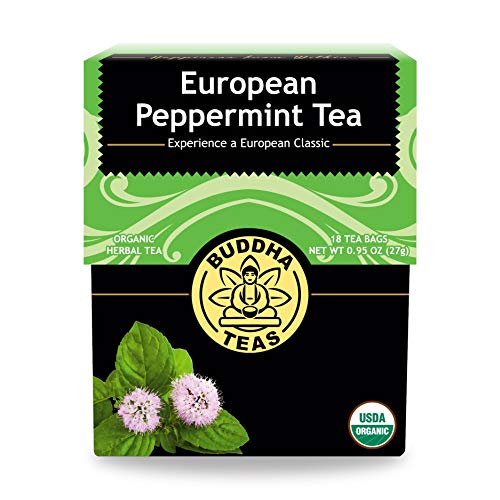
Buddha Teas Organic European Peppermint, 18 Bags
Buddha Teas
The chart's true zero: single-ingredient peppermint leaf, no tea plant involved, 0 mg at any steep length.
Bottom line: The bottom row is the only one with a guarantee: herbal infusions contain no tea leaf, so the caffeine is zero at any strength. Buddha Teas' organic peppermint is our standing example, crisp enough to feel like a real drink rather than an absence.
Origin and grade. USDA Organic certified single-ingredient peppermint leaf in bleach-free bags, per the brand.
Everything above this row is a range; the herbal row is a fact. No Camellia sinensis, no caffeine, whether you steep 2 minutes or 20. Peppermint is the zero-tier pick that still reads bright and awake, which matters at the hours you are down here.
The row's other residents, chamomile, rooibos, hibiscus, have their own rankings in chamomile, rooibos, and hibiscus.
Who should buy it.
Evening drinkers, the caffeine-sensitive, and anyone tapering a day's total to a hard zero.
What we don't like.
Zero is the point, but it means zero lift; the small box also empties fast.
- Chart tier
- Herbal: 0 mg
- Caffeine
- 0 mg at any steep
- Certification
- USDA Organic
- Count
- 18 bags
- Bag
- Bleach-free
What we like.
- Guaranteed zero, any strength
- Crisp, not sleepy
Worth noting.
- No lift by definition
- Small box
How to read the chart
The single numbers in the chart are typical values, not guarantees. USDA FoodData Central measures a standard brewed cup; your own cup can land well above or below it. The clearest evidence for how much it varies is a laboratory study of 20 commercial teas brewed at different serving sizes and steep times (Chin et al., Journal of Analytical Toxicology, 2008). It found white, green, and black teas ranged from 14 to 61 mg per 6 or 8 oz serving, with no observable trend by tea type.
That has two practical meanings. First, the type of tea sets a starting point, and how you brew it decides where you land. Second, a strong green tea can have more caffeine than a weak black tea. The rankings in the chart hold for typical cups, not every cup.
Black tea vs green tea caffeine<p>For what individual brands publish, from Tetley to Twinings to Bigelow, see <a href="/journal/caffeine-in-tea-bag-brands">caffeine in tea bags by brand</a>.</p>
Black tea has more caffeine than green tea in a typical cup: about 47 mg vs about 28 mg per 8 oz by USDA's values (48 vs 29 mg in Mayo Clinic's chart). Both come from the same plant, Camellia sinensis. The gap comes mostly from brewing habits: black tea is usually steeped in boiling water for 3 to 5 minutes, and green tea in cooler water for 1 to 3 minutes. Hotter water and longer steeps pull more caffeine from any leaf.
Brew green tea hot and long, or use a caffeine-rich green like matcha or a shade-grown Japanese tea, and the gap narrows or reverses. For the full comparison beyond caffeine (processing, flavor, brewing), see green tea vs black tea, and for the green row in depth, does green tea have caffeine.
White tea vs green tea caffeine
White tea does not reliably have less caffeine than green tea. The common claim that white tea is the lowest-caffeine true tea is not supported by lab data. In the Chin et al. (2008) analysis, white teas fell inside the same 14 to 61 mg per serving range as green and black teas, and the authors reported no trend by tea type.
Why it varies: white tea is made from young leaves and often unopened buds, and buds tend to carry more caffeine than older leaves. On the other hand, white tea is usually brewed with cooler water, which extracts less. A bud-heavy white tea such as Silver Needle, brewed hot and long, can match or exceed a typical green tea. A leafy white brewed cool and short will usually come in lower.
USDA FoodData Central has no brewed white tea entry, which is why the chart shows a range instead of a single number. For the full side-by-side, see white tea vs green tea and our best white teas.
What changes the caffeine in your cup
- Steep time. Caffeine keeps extracting for several minutes, so a longer steep means more caffeine. This is the easiest lever you control.
- Water temperature. Hotter water extracts caffeine faster. Boiling water on black tea pulls more than 175°F water on green tea. Temperatures by type are in our brewing temperature chart.
- Amount of leaf. Two bags, or a heaping spoon of loose leaf, roughly means more caffeine in the cup.
- Leaf size. Broken leaf and fannings in standard tea bags expose more surface and release caffeine faster than whole leaf.
- Buds and shade. Young buds and shade-grown leaves (the kind used for matcha and gyokuro) tend to be higher in caffeine.
- Re-steeps. Most of the caffeine comes out in the first infusion, so a second steep of the same leaves carries less.
Matcha, decaf, and herbal tea
Matcha sits at the top because you drink the leaf itself instead of an infusion. A review of matcha chemistry (Kochman et al., Molecules, 2021) reports 18.9 to 44.4 mg of caffeine per gram, so a typical 2 g serving (about 1 teaspoon) carries about 38 to 88 mg, and a 4 g serving roughly double. Full conversions are in our matcha caffeine guide and how much caffeine is in matcha.
Decaf tea is low, not zero. USDA lists brewed decaf black tea at about 2 mg per cup, and the Chin et al. lab test found decaffeinated teas under 12 mg per serving. That matters only if you are very sensitive or drink many cups. Our best decaf tea guide covers the options.
Herbal tea is the only true zero. Peppermint, chamomile, hibiscus, and rooibos contain no tea leaf, USDA lists them at 0 mg, and the lab study detected no caffeine in herbal teas. The exception is a blend that adds tea leaves, such as Moroccan mint (green tea plus spearmint). See peppermint vs spearmint tea and the best teas for sleep.
Tea vs coffee and espresso
| Drink | Caffeine |
|---|---|
| Drip coffee, 8 oz | About 95 mg |
| Espresso, 1 oz shot | About 64 mg |
| Matcha, 2 g serving | About 38 to 88 mg |
| Black tea, 8 oz | About 47 mg |
| Green tea, 8 oz | About 28 mg |
| Decaf coffee, 8 oz | About 2 mg |
| Herbal tea, 8 oz | 0 mg |
All values from USDA FoodData Central except matcha (Kochman et al., 2021). A cup of black tea is about half a coffee; a cup of green is under a third. Our tea vs coffee and matcha vs coffee guides go further.
How many cups a day
The FDA says up to 400 mg of caffeine a day is an amount not generally associated with negative effects for healthy adults. Dividing that by the chart's typical values, if tea were your only caffeine:
| Tea | Cups to about 400 mg |
|---|---|
| Matcha, 2 g | About 4 to 10 servings |
| Black tea | About 8 cups |
| Oolong | About 10 cups |
| Green tea | About 14 cups |
| Decaf tea | No practical limit |
| Herbal tea | No caffeine |
Real days mix sources, so add roughly. Timing matters too: many people sleep better if they switch to herbal tea by mid-afternoon. Sensitivity varies, and pregnant readers should ask a doctor about lower limits. This page is not medical advice.
Methodology and sources
- USDA FoodData Central (SR Legacy): caffeine per 100 g converted to an 8 fl oz cup (237 g). Black tea brewed 20 mg (about 47 per cup), green tea brewed 12 mg (about 28), oolong brewed 16 mg (about 38), decaf black tea brewed 1 mg (about 2), herbal and chamomile tea 0, drip coffee 40 mg (about 95), espresso 212 mg (about 64 per 1 oz shot), decaf coffee 1 mg (about 2).
- Mayo Clinic caffeine chart: brewed black tea 48 mg, brewed green tea 29 mg, decaf black tea 2 mg, brewed coffee 96 mg, espresso 63 mg per 1 oz.
- Chin JM et al., "Caffeine content of brewed teas," Journal of Analytical Toxicology, 2008: 20 commercial teas; white, green, and black teas 14 to 61 mg per 6 or 8 oz serving with no trend by type; decaf under 12 mg; no caffeine detected in herbal teas.
- Kochman J et al., "Health Benefits and Chemical Composition of Matcha Green Tea: A Review," Molecules, 2021: 18.9 to 44.4 mg caffeine per gram of matcha.
- FDA: 400 mg a day for healthy adults.
- What we did not do: lab-test the products on this page. Figures describe tea types, not specific boxes.
Questions, answered.
How much caffeine is in one tea bag?
One black tea bag brewed in 8 oz of water gives about 47 mg of caffeine by USDA's typical value, a green tea bag about 28 mg, a decaf bag about 2 mg, and an herbal bag 0 mg. Brand figures vary with the blend and steep time: Tetley USA, for example, puts a cup of its black tea at 50 mg.
How much caffeine is in black tea vs green tea?
A typical 8 oz cup of black tea has about 47 mg of caffeine and green tea about 28 mg, per USDA FoodData Central (Mayo Clinic lists 48 and 29 mg). Brewing moves both numbers: a long, hot steep of green tea can match a short steep of black tea.
How much caffeine is in white tea vs green tea?
White tea has roughly the same caffeine as green tea, not reliably less. In a lab test of 20 commercial teas (Chin et al., Journal of Analytical Toxicology, 2008), white, green, and black teas all ranged from 14 to 61 mg per serving with no consistent trend by type. Green tea's USDA typical value is about 28 mg per 8 oz; USDA has no white tea entry. Bud-heavy whites brewed hot can run higher, leafy whites brewed cool usually run lower.
Does black tea or green tea have more caffeine?
Black tea usually has more, about 47 mg per 8 oz cup vs about 28 mg for green by USDA values. The difference comes largely from how each is brewed, so it is a typical gap rather than a fixed rule.
How much caffeine is in each type of tea?
Per 8 oz cup by USDA typical values: black tea about 47 mg, oolong about 38 mg, green tea about 28 mg, decaf black tea about 2 mg, and herbal tea 0 mg. White tea has no USDA entry and measured 14 to 61 mg per serving in a lab study. Matcha is about 38 to 88 mg per 2 g serving.
Which tea has the most caffeine?
Matcha has the most per serving, about 38 to 88 mg in a 2 g serving, because you drink the whole powdered leaf. Among steeped teas, black tea usually leads at about 47 mg per 8 oz cup, though a long, hot steep pushes any tea higher.
Which tea has the least caffeine?
Herbal teas have none: peppermint, chamomile, hibiscus, and rooibos contain no tea leaf and measure 0 mg. Among true teas, decaf is lowest at about 2 mg per cup (USDA). Among regular teas, green tea has the lowest USDA typical value at about 28 mg; white tea varies too much to rank reliably.
How much caffeine is in tea compared to coffee?
A cup of black tea has about half the caffeine of drip coffee, and green tea under a third. USDA lists drip coffee at about 95 mg per 8 oz, black tea at 47 mg, and green tea at 28 mg. A 1 oz espresso shot is about 64 mg.
Does steeping tea longer increase caffeine?
Yes, a longer steep extracts more caffeine. Caffeine keeps coming out of the leaf for several minutes, and hotter water speeds it up. That is why the chart's numbers are typical values rather than exact amounts.
Is decaf tea caffeine free?
No, decaf tea still has a small amount of caffeine. USDA lists brewed decaf black tea at about 2 mg per cup, and a lab study found decaffeinated teas under 12 mg per serving. For zero caffeine, choose an herbal tea.
How many cups of tea a day is too much caffeine?
For healthy adults, the FDA's 400 mg a day figure works out to about 8 cups of black tea or 14 cups of green tea if tea is your only caffeine. Sensitivity varies, late cups can affect sleep, and pregnant readers should ask a doctor about lower limits. This is not medical advice.
Filed under Explainer
Part of Tea Reference & Data
More tea worth comparing
Whatever you decide, these are the tea bags our reviews keep ranking on top. Live price check on each.
- Check price
Best Overall.
Twinings English Breakfast - Check price

- Check price

Best Fast Brew.
PG Tips Original - Check price

- Check price

- Check price

Best Green.
Ito En Oi Ocha Green Tea
As an Amazon Associate we earn from qualifying purchases, at no cost to you.
Keep reading.
How Much Caffeine Is in Tea?
The narrative companion: the why behind this page's numbers.
Matcha Caffeine by Grams, Teaspoons & Serving Size
The sibling data page: matcha's full conversion tables.
Best Tea for Studying
This chart put to work: building a focus day from high tier to zero.
Does Green Tea Have Caffeine?
The most-asked row of the chart, answered in depth.
Best Decaf Tea
Living in the near-zero row: the decafs actually worth brewing.
Tea Bag Price Index (July 2026)
Our other original dataset: live cost per cup for 162 verified teas.
Green Tea vs Black Tea
Same plant, different processing: caffeine, flavor, and brewing compared.
White Tea vs Green Tea
The two lightest teas head to head, including the caffeine myth.
Peppermint vs Spearmint Tea
The two most common 0 mg herbal teas, compared.