Our Pick: Encha
Check price →The Best Matcha (2026): Ceremonial vs Culinary, Tested
We tested ceremonial and culinary matcha powders across price tiers. Here are the green teas worth whisking, from a $26 daily organic to a $108 cult Uji blend.
By Justin Park · 11 min read · Updated 2026-08-23
★ Our Top Pick
Best organic ceremonial value for daily drinking
A smooth, naturally sweet, USDA-organic Uji matcha that you can actually afford to drink every day.
Not sure yet? Compare all 5 picks below ↓
For most people, the best matcha is Encha Ceremonial Grade, a USDA-organic, first-harvest powder from Uji, Japan that runs about $27 for 30 grams and whisks into a smooth, naturally sweet bowl without the grassy bitterness that turns people off cheaper green powders. It is the rare ceremonial matcha you can drink every morning without flinching at the price. If you only want to buy one tin, buy this one.
But matcha is not one product. Ceremonial grade is shade-grown, stone-milled, first-harvest leaf meant to be whisked with hot water and sipped on its own. Culinary grade is a coarser, more bitter, more affordable powder built to punch through milk, ice, and sweetener in a latte or smoothie. Buying a $108 ceremonial blend for your iced oat-milk latte is a waste; buying culinary matcha for a traditional bowl is a disappointment. The single most useful thing to know before you spend money: match the grade to the cup. Below, our picks for every use and budget, all real powders currently sold, all verified for origin and price.
The short version
- <strong>Best overall:</strong> Encha Ceremonial Grade (First Harvest, Organic), smooth, sweet, USDA-organic Uji matcha at roughly $27 for 30g, the best daily-drinking ceremonial value we found.
- <strong>Ceremonial vs. culinary is the only fork that matters:</strong> ceremonial is shade-grown first-harvest leaf for whisking and sipping; culinary is built to cut through milk and ice in lattes and baking. Match the grade to the cup.
- <strong>Best for lattes:</strong> Jade Leaf Barista Edition (ceremonial-grade, made for milk) or, on a budget, Naoki All Purpose culinary blend from about $15 for 100g.
- <strong>Always check three things:</strong> origin stated (look for Uji, Kyoto, or Kagoshima, Japan), a vivid jade-green color (dull/olive means oxidized or lower grade), and a recent harvest. Real ceremonial matcha is stone-milled and first-harvest.
| Matcha | Grade | Origin | Best for | Price |
|---|---|---|---|---|
| Encha Ceremonial First Harvest | Ceremonial | Uji, Japan | Best overall / daily organic | $27-$32 (30g) |
| Jade Leaf Teahouse Edition | Ceremonial | Japan (first harvest) | Best value per gram | ~$27 (30g/100g) |
| MatchaBar Ceremonial, 80g | Iced and milk lattes | Smooth, round, vivid green | Around $49 / 80g | |
| Jade Leaf Barista Edition | Ceremonial (latte) | Japan | Best for lattes | $16-$30 (30g/100g) |
| Naoki All Purpose Blend | Culinary | Kagoshima, Japan | Best budget for lattes & baking | $15-$30 (40g/100g) |
Verified prices and specs for our matcha picks. Ceremonial grade is for whisking and sipping; culinary grade is for lattes, smoothies, and baking. Prices checked June 2026 and may vary.
01 · Best organic ceremonial value for daily drinking
Best OverallEncha Ceremonial Grade Matcha (First Harvest, Organic)
A smooth, naturally sweet, USDA-organic Uji matcha that you can actually afford to drink every day.
Origin & grade: USDA organic; single origin stated (Uji, Japan); first harvest.
Encha is the matcha we recommend first because it gets the fundamentals right: it's USDA-certified organic, first-harvest, and single-origin from Uji, the Kyoto-area region with the longest pedigree in Japanese green tea, and it tastes like it. Whisked with water just off the boil (around 175°F, never fully boiling), it produces a smooth, slightly sweet bowl with the gentle umami you want and very little of the harsh, hay-like bitterness that makes people decide they 'don't like matcha.'
At about $27 for 30 grams, roughly $0.90 per 2g serving, it sits in a sweet spot: clearly better than supermarket matcha, far cheaper than a Kyoto tea house's flagship. For a daily ritual where you'll go through tins steadily, that price-to-quality ratio is hard to beat.
If you take your matcha as a latte more often than a bowl, you can drop to Encha's latte grade or our culinary pick and save money without losing much, milk masks the nuance you're paying for here. But for a straight bowl, this is the one to start with.
- Grade
- Ceremonial (first harvest)
- Origin
- Uji, Japan
- Organic
- USDA organic
- Size
- 30g (~15 servings)
- Best preparation
- Usucha (whisked bowl) at ~175°F
What we like
- USDA organic, first-harvest, single-origin Uji
- Smooth and naturally sweet with low bitterness
- Excellent quality for the price (~$0.90/serving)
- Vivid jade-green color signals freshness
Worth noting
- 30g goes quickly for daily drinkers
- A little light for fans of thick, intense koicha
Who should buy it: Anyone who wants a genuine ceremonial bowl, whisked with hot water, sipped on its own, without spending $50+ a tin. Also a strong choice for daily drinkers who care about organic certification.
What we don't like: At roughly $27 for 30g it isn't cheap by grocery-aisle standards, and 30g disappears fast if you drink a bowl a day (about 15 servings). Devotees of bolder, koicha-thick matcha may find it a touch light.
Bottom line: The best balance of quality, organic sourcing, and price in matcha. Encha is the tin we'd hand to almost anyone starting out, and keep buying once they're hooked.
02 · Best cafe-style ceremonial for iced lattes
Also Great
MatchaBar Ceremonial Grade Matcha, 80g
The New York matcha cafe's own ceremonial powder: smooth, vivid, and built to stand up to milk and ice.
Origin & grade: Stone-ground Japanese matcha from MatchaBar, the New York cafe brand founded in 2014; more than 4,500 Amazon ratings at 4.4 stars at time of writing.
MatchaBar started as a Brooklyn matcha cafe, and its powder tastes like it was tuned on a latte bar. The colour is a bright spring green, the sift is fine, and whisked with 70C water it froths easily into a creamy, sweet-leaning bowl with a soft umami finish and little of the astringency that makes cheaper ceremonial grades hard to drink daily. Where it separates from the pack is in milk: it does not vanish into oat milk the way lighter powders do, and over ice it keeps its colour and flavour.
Drunk plain and compared with Encha, Encha has a little more depth and sweetness; MatchaBar is rounder and simpler. For a daily iced latte, that is the better profile. The 80g tin is the sweet spot on price per gram; the 30g is a sensible trial size.
- Grade
- Ceremonial
- Origin
- Japan
- Size
- 80g (also 30g, 200g)
- Best for
- Lattes, iced matcha, daily bowls
- Organic
- Not certified
What we like
- Smooth, low bitterness
- Holds up in milk and over ice
- Real cafe brand with a long track record
- Three tin sizes
Worth noting
- Not certified organic
- Slightly less nuance plain than Encha
Who should buy it: Daily latte drinkers, especially iced, and anyone who found their last ceremonial matcha too bitter or too faint once milk went in.
What we don't like: Plain, it is a shade less complex than Encha or Jade Leaf Teahouse, and the per-gram price is above the value picks here.
Bottom line: MatchaBar is the pick for people who mostly drink matcha as a latte, hot or iced. It is a smooth, low-bitterness ceremonial grade with enough body to read through oat or whole milk, and the 80g tin is the right size for a daily latte habit. Whisked plain it is very good but a touch less nuanced than Encha.
03 · Best everyday ceremonial value (best price-per-gram)
Best Value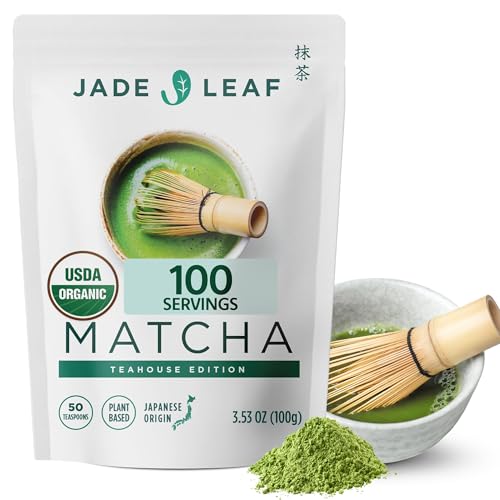
Jade Leaf Organic Ceremonial Matcha, Teahouse Edition
Honest first-harvest ceremonial matcha at the best price-per-gram of any pick here, buy the 100g and stop overthinking it.
Origin & grade: USDA organic; first harvest; product of Japan.
Jade Leaf is the widely available, no-nonsense brand that made organic ceremonial matcha a grocery-store reality, and the Teahouse Edition is its straight-bowl line. It's first-harvest, USDA-organic, and a product of Japan, the same boxes our top pick ticks, for a price that, in the 100g size, undercuts nearly everything else here per gram.
The flavor is clean and properly green, with a little more vegetal bite than Encha, noticeable side by side, invisible most mornings. Whisk it the same way: sift to avoid clumps, water around 175°F, brisk W-motion until frothy.
This is the pick for people who'd rather not agonize. It's good, it's organic, it's competitively priced and it's easy to find. The only mistake is buying the small tin, go straight for the 100g.
- Grade
- Ceremonial (first harvest)
- Origin
- Japan
- Organic
- USDA organic
- Size
- 30g / 100g
- Best preparation
- Usucha (whisked bowl)
What we like
- Best price-per-gram in the 100g size
- USDA organic and first harvest
- Widely available online and in stores
- Reliable, clean green flavor
Worth noting
- Slightly more vegetal than pricier picks
- 30g tin is poor value, buy the 100g
Who should buy it: Daily drinkers who want organic ceremonial matcha without paying boutique prices, especially anyone buying the 100g size, where the per-gram cost drops dramatically.The 30g tin is priced close to the 100g pouch, so the small size is poor value; buy big.
Bottom line: The value play. Not the most refined bowl on this list, but the most matcha-for-your-money, and a genuinely good daily drinker.
04 · Best ceremonial-grade matcha built for lattes
Best for Lattes
Jade Leaf Organic Ceremonial Matcha, Barista Edition
A ceremonial-grade matcha blended to stay bold and green through milk and ice, the smart middle ground for latte people.
Origin & grade: USDA organic; origin stated (Japan); first harvest.
Most people buying matcha are actually buying latte ingredients, and pairing a delicate sipping matcha with milk is both wasteful and slightly pointless, the milk flattens the nuance you paid for. Jade Leaf's Barista Edition solves this honestly: it's still ceremonial-grade, USDA-organic, first-harvest leaf from Japan, but blended specifically to stay vivid green and assertive when it hits milk, ice, and sweetener.
In an iced oat-milk latte it holds a clean, full matcha flavor and a bright color instead of the muddy, washed-out green you get when a too-delicate matcha disappears into dairy. Starting around $16 for 30g (and better value at 100g), it costs less than a premium sipping tin precisely because it's optimized for a different job.
If you want one tin that does both bowls and lattes, get our top pick and accept a slight latte compromise. If lattes are 90% of your matcha life, buy this.
- Grade
- Ceremonial (latte-optimized)
- Origin
- Japan
- Organic
- USDA organic
- Size
- 30g / 100g
- Best preparation
- Lattes (hot or iced)
What we like
- Holds color and flavor through milk and ice
- Ceremonial-grade quality, organic, first harvest
- Cheaper than premium sipping tins
- Great value in the 100g size
Worth noting
- Less refined as a plain whisked bowl
- Built for milk, not for usucha purists
Who should buy it: Iced and hot matcha-latte drinkers who want better-than-culinary quality but don't want to drown a $50 ceremonial tin in oat milk. The Barista Edition is purpose-built for exactly this.
What we don't like: As a straight whisked bowl it's a step below the Teahouse Edition and the Kyoto blends, it's engineered for milk, not for sipping plain. Not the pick if you mostly drink usucha.
Bottom line: If your matcha almost always meets milk, this is the right buy: ceremonial-grade smoothness, but built to hold its color and flavor in a latte.
05 · Best budget culinary matcha for lattes, smoothies & baking
Best Budget
Naoki Matcha Organic All Purpose Blend (Culinary Grade)
Organic culinary matcha from Kagoshima that holds its color and punch in heat and milk, the workhorse for lattes, smoothies, and baking.
Origin & grade: JAS/USDA-recognized organic; origin stated (Kagoshima, Japan).
Culinary matcha exists for a reason, and Naoki's Organic All Purpose Blend is the one we'd stock. It's organically grown in Kagoshima, Japan's second great matcha region, and it's engineered to keep a strong matcha flavor and a vibrant green even under the high heat of baking and the dilution of milk.
From about $15 for 100g, the per-cup cost is a fraction of any ceremonial tin, which is the whole point: you can make a daily latte without burning through pricey sipping matcha. It blends smoothly, doesn't go dull in milk, and bakes into a real, green, matcha-forward flavor rather than a faint suggestion of one.
Pair it with one ceremonial tin from this list, Naoki for everything with milk or heat, your ceremonial pick for the morning bowl, and you've got the whole spectrum covered for less than the cost of a single premium tin.
- Grade
- Culinary
- Origin
- Kagoshima, Japan
- Organic
- JAS/USDA-recognized organic
- Size
- 40g / 100g
- Best preparation
- Lattes, smoothies, baking
What we like
- Very low cost per cup (from ~$15/100g)
- Holds color and flavor in milk and heat
- Organic, origin-stated Kagoshima leaf
- Ideal workhorse for lattes and baking
Worth noting
- Bitter and astringent as a plain bowl (by design)
- Not ceremonial, don't sip it straight
Who should buy it: Anyone making matcha lattes, smoothies, ice cream, or baked goods who doesn't want to waste ceremonial matcha, and wants to keep per-cup cost low.
What we don't like: It's frankly bitter and astringent whisked plain with water, as it should be; this is culinary grade and not meant for a bare bowl. Color is good but not the electric jade of top ceremonial powders.
Bottom line: The best inexpensive culinary matcha for everything that isn't a traditional bowl. Buy this for your lattes and your baking, and save the ceremonial tins for sipping.
How to whisk a proper bowl of matcha (usucha)
- 1
Sift the powder
Sift 1-2 grams (about ½-1 teaspoon) of matcha through a fine strainer into a warm bowl. Sifting breaks up clumps so you get a smooth, lump-free bowl.
- 2
Add hot, not boiling, water
Pour in about 2 ounces (60 ml) of water at roughly 175°F (80°C). Water at a full boil scorches matcha and turns it bitter; let boiled water cool for a minute or two first.
- 3
Whisk in a W or M motion
Using a bamboo whisk (chasen), whisk briskly in a zig-zag W or M pattern, not a circular stir, for 15-30 seconds until a fine, even foam forms on top.
- 4
Drink it fresh
Sip directly from the bowl while hot and frothy. Matcha is a suspension, not an infusion, so it separates quickly, don't let it sit.
- 5
For a latte, switch grades
For a latte, use a barista or culinary grade instead, whisk the matcha with a splash of hot water into a smooth paste, then top with steamed or cold milk over ice.
Questions, answered
What's the difference between ceremonial and culinary matcha?
Ceremonial grade is shade-grown, first-harvest, stone-milled leaf meant to be whisked with hot water and sipped on its own, it's smoother, sweeter, and more vivid green. Culinary grade is a coarser, more bitter, more affordable powder built to keep its flavor and color through milk, ice, sugar, and the heat of baking. Use ceremonial for plain whisked bowls and culinary for lattes, smoothies, and baked goods. Buying a premium ceremonial tin for a sweetened latte wastes most of what you're paying for.
What is the best matcha overall?
For most people, Encha Ceremonial Grade (First Harvest, Organic) is the best matcha: it's USDA-organic, single-origin from Uji, Japan, smooth and naturally sweet, and priced around $27 for 30g, the best daily-drinking ceremonial value we found. If you mainly make lattes, a latte-optimized blend like Jade Leaf Barista Edition or a budget culinary matcha like Naoki is the smarter buy.
How can I tell if matcha is good quality?
Check three things. Color: high-quality matcha is a vivid, almost electric jade green; dull, yellowish, or olive tones signal older, lower-grade, or oxidized powder. Origin: look for a stated region, Uji and Kyoto, or Kagoshima, in Japan are the benchmarks. Harvest and grade: real ceremonial matcha is first-harvest and stone-milled. Price is a rough guide too, genuine ceremonial matcha rarely costs only a few dollars for a large bag.
What water temperature should I use for matcha?
About 175°F (80°C), hot but well below boiling. Boiling water scorches the delicate leaf and brings out harsh bitterness. If you don't have a thermometer, boil your water and let it cool for a minute or two before whisking. Use roughly 2 ounces of water to 1-2 grams of matcha for a standard whisked bowl (usucha).
Is more expensive matcha always better?
No. Beyond a solid ceremonial baseline, around $25-$50 for 30-40g, you're paying for refinement, single-region sourcing, and brand cachet that mostly matter when you sip matcha plain.For lattes, an inexpensive culinary or barista blend often performs better than an over-qualified ceremonial one.
How much matcha should I use per bowl, and how long does a tin last?
A standard whisked bowl (usucha) uses about 1-2 grams of matcha, or roughly ½ to 1 teaspoon. That means a 30g tin makes about 15-30 bowls, and a 100g pouch makes roughly 50-100. If you drink a bowl a day, a 30g tin lasts about two to four weeks, which is why daily drinkers should favor the 100g sizes for better value, and use opened matcha within a few weeks for peak color and flavor.
Is MatchaBar matcha good?
Yes. MatchaBar is the New York matcha cafe's own ceremonial-grade powder, and it is one of the best choices for lattes: smooth, low in bitterness, and strong enough in colour and flavour to read through milk and ice. Whisked plain it is very good, though Encha has a little more depth. It is not certified organic.
Keep reading
Best Matcha for Lattes
Iced and hot, the powders that punch through milk.
Encha Tea Review (2026): Is It Worth It? Best & Worst Matcha Blends
Our full hands-on review of Encha, taste, value, and what to buy.
Jade Leaf Matcha Review: Is This Best-Selling Matcha Legit?
Our full hands-on review of Jade Leaf Matcha, taste, value, and what to buy.