Our Pick: Ippodo Tea
Check price →Matcha vs Coffee: Caffeine, Energy and Crash Compared
Both wake you up. Only one comes with a built-in brake pedal. Here is the honest head-to-head on caffeine, focus and the dreaded crash.
By Justin Park · 11 min read · 2026-06-14
★ Our Top Pick
A real, authentic matcha to start with
An authentic, everyday-grade Japanese matcha from a 300-year-old Kyoto house, the honest way to feel the matcha energy curve for yourself.
Not sure yet? Compare all 2 picks below ↓
If you want a sharp, immediate jolt, a strong cup of coffee wins every time. But if your real goal is steady, jitter-light energy that lasts the whole morning and tapers gently instead of slamming you into a 2 p.m. wall, matcha is usually the better tool. That is the bottom line, and it comes down to one compound coffee simply does not contain: L-theanine, an amino acid in green tea that blunts caffeine's rough edges and changes the shape of your energy curve.
The numbers matter here. A typical 8 oz cup of brewed coffee carries roughly 95 mg of caffeine, while a 1-teaspoon (2 g) serving of matcha delivers about 38-70 mg, depending on grade and how much powder you whisk in (USDA FoodData Central; Mayo Clinic). So coffee is usually the heavier hitter on caffeine alone. The difference buyers actually feel, though, is not the dose, it is the delivery. Coffee front-loads; matcha drip-feeds.
We are an independent, reader-funded tea desk. We do not sell placement and we are not anti-coffee, most of our editors drink both. This guide compares the two honestly on caffeine, onset, focus, the crash, jitters, stomach feel and antioxidants, points you to a real matcha worth starting with, and flags exactly when coffee is still the smarter call. For health-adjacent claims we use cautious language: matcha may support calmer alertness, but it is not a treatment for anything, and caffeine affects everyone differently.
The short version
- Coffee usually has more caffeine per cup (~95 mg vs ~38-70 mg for a 2 g matcha serving), so it hits harder and faster.
- Matcha contains L-theanine, which coffee lacks entirely. L-theanine promotes a calm, focused state and smooths caffeine's spike, giving longer, steadier energy with fewer jitters.
- The infamous crash is mostly a coffee phenomenon: a fast caffeine peak means a faster drop. Matcha's slower, theanine-modulated release tends to taper instead of crash.
- On an empty stomach, coffee is more likely to cause acid reflux and the shakes; matcha is generally gentler, though it is not acid-free and still contains caffeine.
- Choose coffee for maximum alertness, cold mornings and habit; choose matcha for sustained focus, anxiety-prone afternoons, and pairing caffeine with calm.
| Factor | Matcha (2 g serving) | Coffee (8 oz brewed) |
|---|---|---|
| Caffeine per serving | ~38-70 mg | ~95 mg |
| L-theanine | Yes (naturally present) | None |
| Onset of energy | Gradual (15-45 min) | Fast (15-30 min) |
| Duration | Longer, steadier (3-6 hrs) | Sharper peak, shorter (2-4 hrs) |
| Crash risk | Low, tends to taper | Higher, faster drop-off |
| Jitters / anxiety | Lower (theanine buffers) | Higher at equal caffeine |
| Acidity / stomach | Gentler, but not acid-free | More acidic; reflux-prone on empty stomach |
| Antioxidants | High in catechins (incl. EGCG) | High in chlorogenic acids |
| Best for | Sustained focus, calm energy | Maximum, immediate alertness |
| Prep effort | Whisk powder with hot water | Brew machine or pour-over |
Matcha vs coffee, head to head. Caffeine figures are typical ranges for an 8 oz cup of brewed coffee and a 2 g (1 tsp) serving of matcha; individual products and brewing vary.
01 · A real, authentic matcha to start with
Editors' starting pointIppodo Tea Ikuyo Matcha (40g can)
An authentic, everyday-grade Japanese matcha from a 300-year-old Kyoto house, the honest way to feel the matcha energy curve for yourself.
Origin & grade: Produced by Ippodo, a Kyoto tea house founded in 1717; stone-ground Japanese tencha, single-origin Japan.
Matcha quality maps directly onto the experience this article describes. Cheap, oxidized, bitter powder makes people conclude they 'don't like matcha' when what they actually disliked was a stale culinary grade. Ippodo Tea has been selling Japanese tea from Kyoto since 1717, and the Ikuyo grade is its widely available everyday matcha, bright green, finely stone-ground, and balanced rather than harsh.
Whisk about 1 teaspoon with 2-3 oz of off-boil water (around 175 F / 80 C) until frothy, then top with more hot water or milk. Skip boiling water, which scalds the powder and turns it bitter. Stored sealed and cool, the can stays fresh for a few weeks once opened. Use a real matcha like this as your baseline before judging whether matcha's energy suits you better than coffee's.
- Origin
- Kyoto, Japan
- Form
- Stone-ground matcha powder
- Caffeine per 2g serving
- ~38-70 mg
- Serving
- ~1 tsp whisked with hot water
- House founded
- 1717
What we like
- Authentic Japanese matcha from a centuries-old Kyoto house
- Smooth, balanced flavor, not bitter or grassy-harsh
- Affordable enough for daily use
- Lets you experience the real L-theanine + caffeine effect
Worth noting
- Costs more per cup than coffee or bagged green tea
- Requires a whisk or frother for best texture
- Loses freshness quickly once the can is opened
Who should buy it: Anyone who wants to honestly compare matcha to coffee with authentic powder, and daily drinkers who want a dependable, non-bitter cup without paying top-ceremonial prices.
What we don't like: It is pricier per serving than supermarket matcha, and like all fine matcha it must be stored sealed and used within weeks of opening or it dulls. A whisk (chasen) or a small frother helps a lot.
Bottom line: If you want to actually test the matcha-vs-coffee claim rather than read about it, start with a genuine ceremonial-style Japanese matcha rather than a culinary blend cut for lattes. Ippodo's Ikuyo is an approachable, real-deal entry point: smooth enough to drink whisked with just hot water, affordable enough to use daily, and authentic enough that the L-theanine-to-caffeine balance comes through. This is the cup that lets you judge the energy curve fairly.
02 · Organic, third-party-tested matcha
Best certified-organic option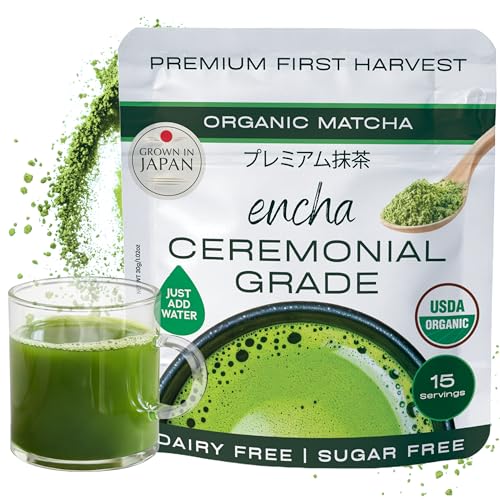
Encha Ceremonial Grade Organic Matcha (30g)
USDA Organic, first-harvest Uji matcha for drinkers who want certification and lab testing behind their daily cup.
Origin & grade: USDA Certified Organic; sourced from first-harvest leaves in Uji, Japan; brand publishes third-party heavy-metal and contaminant testing.
Because you consume the entire ground leaf with matcha (not just an infusion), sourcing and testing carry more weight than they do with steeped tea. Encha leans into that: USDA Organic certification, first-harvest (ichibancha) leaves from Uji, one of Japan's most respected matcha regions, and published third-party testing for contaminants and heavy metals.
Prepared properly with off-boil water, Encha's ceremonial grade is sweet, creamy and low in astringency, an easy daily driver if you are switching off coffee and want minimal bitterness. Pay attention to the same prep rules: water under boiling, a proper whisk, and a sealed, cool storage spot.
- Origin
- Uji, Japan
- Certification
- USDA Organic
- Harvest
- First harvest (ichibancha)
- Caffeine per 2g serving
- ~38-70 mg
- Testing
- Published third-party heavy-metal testing
What we like
- USDA Certified Organic, first-harvest Uji leaves
- Published third-party contaminant testing
- Naturally sweet, low-bitterness flavor
- Forgiving for beginners drinking matcha straight
Worth noting
- Among the pricier matchas per gram
- Perishable once opened
- Overkill for sweetened latte recipes
Who should buy it: Drinkers who want USDA Organic certification and published lab testing, plus anyone sensitive to bitterness who wants a naturally sweet ceremonial grade.
What we don't like: Premium pricing, and like any fine matcha it is perishable once opened. Ceremonial grade is wasted in heavily sweetened lattes, use a culinary grade for those.
Bottom line: If certification matters to you, and with any powdered leaf you ingest whole, testing is a reasonable thing to want, Encha is the cleaner-label pick. It is USDA Organic, sourced from first-harvest Uji leaves, and the brand publishes lab testing for heavy metals. The flavor is naturally sweet and low in bitterness, which makes it forgiving for newcomers drinking matcha straight.
The short answer: which should you drink?
Drink matcha if your problem is the afternoon crash, caffeine jitters, anxiety, or you want focus that lasts through a long task without a hard comedown. The L-theanine does real work here.
Drink coffee if you need maximum alertness fast, you love the ritual and taste, you are battling a brutal early start, or you simply tolerate caffeine well and don't crash. There is no shame in coffee, it is just a blunter instrument.
Many people land on a hybrid: coffee for the first cup, matcha after that to extend energy without stacking jitters. Whatever you choose, total caffeine is what matters for sleep, keep an eye on the cumulative dose, not just the source.
Caffeine: coffee usually wins on raw dose
Let's settle the number first. An 8 oz cup of brewed coffee averages about 95 mg of caffeine, per the USDA and Mayo Clinic, though a large coffeehouse drink can run far higher. A 1-teaspoon (2 g) serving of matcha lands around 38-70 mg depending on grade and how heavily you dose the powder.
So on caffeine alone, coffee typically hits harder. If your single goal is 'wake me up as fast and hard as possible,' coffee is the rational choice. But raw caffeine is only one variable, and arguably the least interesting one. How that caffeine arrives, and what rides along with it, is where matcha pulls ahead for a lot of people.
L-theanine: the ingredient coffee simply doesn't have
Here is the crux of the entire comparison. Matcha contains L-theanine, an amino acid that coffee contains none of. L-theanine is associated with a calm, focused, relaxed-alert mental state, and research on caffeine and L-theanine together suggests the pairing can improve attention while reducing the edginess caffeine alone can produce.
Because matcha is shade-grown and you drink the whole powdered leaf, its L-theanine content is high relative to ordinary steeped green tea. That is the mechanism behind matcha's signature 'calm energy': the caffeine still lifts you, but the theanine keeps the lift smooth. This is a may-support claim, not a cure, but it is well-grounded and it is the single biggest reason matcha and coffee feel different.
The energy curve: spike vs slow burn
Picture two lines on a graph. Coffee is a steep mountain: a fast climb to a high peak, then a quick descent, that descent is the crash. Matcha is a rolling hill: a gentler rise, a lower but broader plateau, and a soft taper back down.
The L-theanine and the way matcha's compounds are absorbed slow the caffeine's effect, so energy tends to last longer and arrive more evenly. People often describe coffee as 'on then off' and matcha as 'steady all morning.' If you have ever felt great an hour after coffee and useless two hours later, you have met the spike. Matcha is built to avoid exactly that.
Jitters, anxiety and the stomach
At an equal caffeine dose, coffee is more likely to produce jitters and that buzzy, anxious overstimulation, partly because there's no L-theanine to temper it, and partly because coffee's caffeine hits faster. For anxiety-prone drinkers, matcha is frequently the more comfortable choice.
On digestion: coffee is acidic and, on an empty stomach, can trigger reflux, a churning gut or the shakes for sensitive people. Matcha is generally gentler on the stomach, but it is not acid-free and still contains caffeine, so it is not a free pass, drinking either with or after food helps. If coffee reliably upsets your stomach, matcha is well worth a two-week trial.
Antioxidants and the rest of the health picture
Both drinks are antioxidant powerhouses, just with different headline compounds. Matcha is rich in catechins, especially EGCG, and because you ingest the whole leaf you get a concentrated dose. Coffee is a leading source of chlorogenic acids and is genuinely one of the biggest antioxidant contributors in many people's diets simply because they drink so much of it.
Neither is a magic bullet, and we won't pretend otherwise. Matcha may support focus and steady energy and contributes catechins; coffee delivers polyphenols and a well-studied alertness boost. The healthiest choice is the one that fits your body, your sleep and your stomach, which is exactly why the crash-and-jitters question usually decides it.
How to switch from coffee to matcha without misery
If you want to try matcha as a coffee replacement, ease in. Going cold-turkey off coffee can bring on caffeine-withdrawal headaches regardless of what you switch to. A gentle plan: keep your morning coffee for week one, but replace your second cup with matcha. In week two, swap the morning cup too.
Use real, fresh matcha (see our picks above), whisk it with off-boil water around 175 F / 80 C, never boiling, and give it two weeks before judging. The calm-energy effect is most obvious when you're not stacking it on top of a large coffee. Track your afternoons: the clearest sign matcha suits you is a 2-4 p.m. that no longer collapses.
Key terms
- L-theanine
- An amino acid found almost exclusively in tea (and especially concentrated in shade-grown green tea like matcha). It promotes a relaxed-yet-alert state and is thought to smooth caffeine's stimulation, reducing jitters.
- The crash
- The slump that follows a caffeine peak as blood levels fall and adenosine rebounds. Faster, higher peaks (typical of coffee) tend to produce a more noticeable crash than slow, steady curves.
- Catechins (EGCG)
- Antioxidant compounds abundant in green tea. EGCG (epigallocatechin gallate) is the most studied and is present at high levels in matcha because you consume the whole leaf.
- Ceremonial vs culinary grade
- Ceremonial matcha is made from young, first-harvest leaves for drinking straight; culinary grade is a coarser, more bitter powder meant for lattes, baking and smoothies.
- Shade-growing
- Covering tea plants for weeks before harvest, which boosts chlorophyll and L-theanine and gives matcha its vivid green color and umami sweetness.
Questions, answered
Does matcha have more caffeine than coffee?
Usually no. A standard 8 oz cup of brewed coffee has about 95 mg of caffeine, while a 2 g (1 tsp) serving of matcha has roughly 38-70 mg. Coffee typically delivers more caffeine per serving. Matcha's advantage is not the dose, it's the L-theanine that makes the energy feel calmer and last longer.
Why does matcha give calmer energy than coffee?
Matcha contains L-theanine, an amino acid that coffee lacks entirely. L-theanine promotes a relaxed-but-alert state and appears to smooth caffeine's stimulation, reducing jitters. Combined with matcha's slower caffeine release, that produces steady, longer-lasting energy instead of a sharp spike and crash.
Will I crash on matcha the way I do on coffee?
Most people crash much less on matcha. The crash is largely a function of how fast caffeine peaks and falls. Coffee spikes high and drops quickly; matcha rises more gently and tapers, modulated by L-theanine. You may still feel a mild dip, especially if you're under-slept, but it's typically far softer than a coffee crash.
Is matcha better than coffee for anxiety?
For many anxiety-prone people, yes, at an equal caffeine dose, matcha tends to feel less jittery because L-theanine buffers the stimulation. That said, matcha still contains caffeine, which can aggravate anxiety in sensitive individuals, so it's not anxiety-free. It may support a calmer experience, but it isn't a treatment. If caffeine is a known anxiety trigger for you, reduce the total dose regardless of source.
Can I drink matcha and coffee on the same day?
Yes, and many people do, coffee first, matcha later to extend energy without piling on jitters. The thing to watch is total daily caffeine. Health authorities generally consider up to about 400 mg of caffeine a day safe for most healthy adults; combining both can add up faster than you'd think, especially with large coffeehouse drinks.
Is matcha gentler on an empty stomach than coffee?
Generally yes. Coffee is acidic and can trigger reflux or stomach upset on an empty stomach, while matcha is usually gentler. But matcha isn't acid-free and still contains caffeine, so it can still bother very sensitive stomachs. Having either with or after food helps.
What kind of matcha should I buy to compare it to coffee?
Use a genuine Japanese ceremonial or everyday-grade matcha rather than a cheap culinary blend, because quality strongly affects both flavor and the calm-energy experience. An authentic, fresh matcha whisked with off-boil water (around 175 F / 80 C) gives you the real L-theanine-and-caffeine effect this article describes.