Our Pick: Ippodo
Check price →How Much Caffeine Is in Matcha? (vs Coffee & Green Tea)
A clear milligram answer per serving, plus why matcha's caffeine feels calmer than coffee thanks to L-theanine.
By Justin Park · 9 min read · Updated 2026-08-07
★ Our Top Pick
A genuine Kyoto ceremonial-grade benchmark
A traditional Kyoto house with three centuries of tea history; Ikuyo is its approachable everyday ceremonial grade.
Not sure yet? Compare all 4 picks below ↓
The short answer: a standard serving of matcha (1 teaspoon, about 2 grams of powder) delivers roughly 60-70 mg of caffeine. That puts it well below a typical 8-ounce cup of brewed coffee (about 95 mg) and well above a steeped cup of regular green tea (about 28 mg). Because you whisk and drink the entire leaf as a suspension rather than steeping and discarding it, matcha is more caffeinated, gram for gram, than almost any other tea.
But the milligram number only tells half the story. The reason people describe matcha as a "calm focus" or "no-jitters" caffeine is a single amino acid: L-theanine. Matcha is unusually rich in it, and L-theanine has been studied for its ability to take the edge off caffeine's stimulation while preserving the alertness. That combination, moderate caffeine plus meaningful L-theanine, is what makes matcha feel different from a fast, spiky cup of coffee.
Below, we give you the hard numbers (with a real comparison table), explain the science of why matcha feels smoother, and walk through the variables, grade, serving size, water temperature, and how much powder you actually scoop, that move your real-world dose up or down. We also name a handful of genuine, widely available matcha products so you can buy with confidence. We are reader-supported and may earn a commission on purchases, but our recommendations are never for sale.
The short version
- A standard 2 g serving of matcha contains roughly 60-70 mg of caffeine, about two-thirds of an 8 oz cup of coffee (~95 mg) and more than twice a cup of steeped green tea (~28 mg).
- You ingest the whole leaf with matcha, so you get more caffeine per gram than with leaf tea you steep and strain.
- Matcha's signature "calm alertness" comes from L-theanine, an amino acid that research suggests blunts caffeine's jittery edge while keeping you focused.
- Ceremonial-grade matcha (younger, shade-grown leaves) is highest in both L-theanine and flavor; culinary grade is fine for lattes and baking.
- Your actual dose is driven mostly by how much powder you use, a heaping 'caffè-style' scoop of 4 g can push a serving past 120 mg.
| Drink | Typical serving | Caffeine (approx.) | L-theanine? | Notes |
|---|---|---|---|---|
| Matcha (standard) | 1 tsp / 2 g powder | 60-70 mg | Yes, high | Whole leaf consumed; high L-theanine |
| Matcha (latte, heaping scoop) | 3-4 g powder | 90-130 mg | Yes, high | Café servings can rival coffee |
| Brewed coffee | 8 oz / 240 ml | ~95 mg | No | Spikier energy; no L-theanine |
| Espresso | 1 oz / 30 ml shot | ~63 mg | No | Concentrated; small volume |
| Green tea (steeped) | 8 oz / 240 ml | ~28 mg | Yes, moderate | Leaf discarded after steeping |
| Black tea (steeped) | 8 oz / 240 ml | ~47 mg | Yes, moderate | More caffeine than green |
Caffeine at a glance: matcha vs. coffee vs. other common drinks (per standard serving).
01 · A genuine Kyoto ceremonial-grade benchmark
Editors' BenchmarkIppodo Tea Ikuyo Matcha
A traditional Kyoto house with three centuries of tea history; Ikuyo is its approachable everyday ceremonial grade.
Origin & grade: Produced by Ippodo, a Kyoto tea merchant established in 1717; shade-grown Japanese tencha, stone-milled.
Ippodo has been selling Japanese tea from Kyoto since 1717, and that longevity shows in the consistency of the powder. Ikuyo is its entry ceremonial grade: smooth enough to drink usu-cha (thin, whisked with water) without the harsh, grassy bitterness that plagues cheap matcha.
For caffeine, treat it like any ceremonial matcha: roughly 60-70 mg in a standard 2 g serving. Use a touch more powder for a stronger cup and you will climb toward 90+ mg.
- Grade
- Ceremonial
- Origin
- Kyoto, Japan
- Caffeine (2 g)
- ~60-70 mg
- Best use
- Whisked usu-cha
What we like
- Centuries-old Kyoto producer
- Smooth, low-bitterness flavor
- High L-theanine ceremonial grade
Worth noting
- Higher price per gram
- Best consumed quickly after opening
Who should buy it: Anyone who wants to learn the true flavor of quality matcha, or who drinks it whisked with just water.
What we don't like: Premium pricing per gram, and like all fine matcha it loses brightness within weeks of opening, buy a small tin and drink it fresh.
Bottom line: If you want to taste what ceremonial-grade matcha is supposed to be, vivid green, smooth, low astringency, Ippodo is the reference point we measure others against. Ikuyo is the right tin to start with.
02 · Best value ceremonial grade for daily drinking
Best Value
Jade Leaf Matcha Ceremonial Grade Green Tea Powder
Sourced from Japan, USDA organic, and priced so you can drink it every morning without flinching.
Origin & grade: USDA Organic certified; sourced from Uji and Kagoshima, Japan, per the brand.
Jade Leaf built its reputation on making authentic Japanese matcha affordable. Its ceremonial grade is USDA organic, smooth enough to whisk with water, and forgiving in lattes.
If you make a latte with a fuller scoop (3-4 g), your cup can land closer to 90-130 mg, which is genuinely coffee-adjacent.
- Grade
- Ceremonial
- Origin
- Japan
- Certification
- USDA Organic
- Caffeine (2 g)
- ~60-70 mg
What we like
- Strong value per gram
- USDA organic
- Versatile for tea or lattes
Worth noting
- Less nuanced than boutique grades
- Flavor varies slightly batch to batch
Who should buy it: Daily matcha drinkers who want quality without the Kyoto-boutique price.
What we don't like: Flavor is good but not as nuanced as top-tier single-origin tins; the everyday workhorse, not the showpiece.
Bottom line: The matcha we most often recommend to people building a daily habit: real Japanese ceremonial-grade powder at a price that survives daily use.
03 · Single-origin organic with transparent sourcing
Best Single-Origin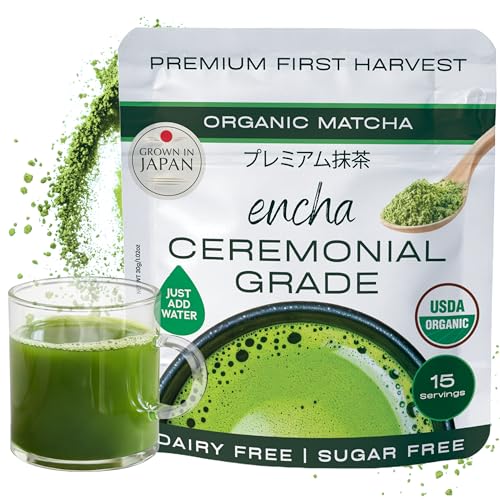
Encha Ceremonial Grade Organic Matcha
First-harvest, single-source organic matcha from Uji, Japan, with unusually clear origin information.
Origin & grade: USDA Organic; first-harvest, single-origin from Uji, Japan, per the producer.
Encha emphasizes first-harvest (ichiban-cha) leaves from a single organic source in Uji. First-harvest leaves are the youngest, shade-grown for weeks, and that is exactly the profile associated with the highest L-theanine content.
Caffeine sits in the same ~60-70 mg per 2 g range as other ceremonial grades; the premium here is flavor and traceability, not a dramatically different stimulant load.
- Grade
- Ceremonial (first harvest)
- Origin
- Uji, Japan
- Certification
- USDA Organic
- Caffeine (2 g)
- ~60-70 mg
What we like
- First-harvest leaves
- Single-origin transparency
- USDA organic
Worth noting
- Higher price
- Limited to one flavor profile
Who should buy it: Buyers who care about single-origin sourcing and organic certification.
What we don't like: Costs more than blended ceremonial powders; the traceability premium is real.
Bottom line: When you want to know exactly where your matcha comes from, Encha's first-harvest single-origin organic is one of the most transparent options on Amazon.
04 · Lattes, smoothies, and baking
Best for Lattes
Naoki Matcha Culinary Blend
A purpose-built culinary blend that holds its flavor against milk, sweetener, and heat.
Origin & grade: Japanese-sourced culinary blend formulated to stand up to milk and sweeteners.
Ceremonial matcha is wasted in a sweetened latte, its delicate notes vanish under milk. Naoki's culinary blend is built to push through. It is more robust and slightly more astringent on its own, which is a feature, not a flaw, once it is in a drink.
Because latte recipes often call for a heaping scoop, a café-style matcha latte can carry well over 100 mg of caffeine. If you are sensitive, measure your powder.
- Grade
- Culinary
- Origin
- Japan
- Best use
- Lattes / baking
- Caffeine (2 g)
- ~55-70 mg
What we like
- Holds flavor against milk
- Cost-effective for daily lattes
- Robust, full-bodied
Worth noting
- Astringent on its own
- Not for whisked usu-cha
Who should buy it: Latte makers, smoothie blenders, and home bakers.
What we don't like: Too bold and astringent to enjoy as a simple whisked tea with water.
Bottom line: If most of your matcha goes into lattes, smoothies, or baked goods, a culinary grade like Naoki gives you the right flavor for less money than wasting ceremonial powder under a cup of oat milk.
The bottom line on matcha caffeine
A standard serving of matcha, 1 teaspoon, or about 2 grams of powder whisked with water, contains roughly 60 to 70 mg of caffeine. For comparison, the U.S. Department of Agriculture and FDA peg an 8-ounce cup of brewed coffee at about 95 mg, and most references put steeped green tea around 28 mg per cup.
The single most important thing to understand is why matcha out-punches regular green tea despite both coming from the same plant, Camellia sinensis. With ordinary green tea you steep the leaves and throw them away, extracting only part of the caffeine. With matcha, the leaf is ground into powder and you drink all of it. Nothing is left behind, so you get substantially more caffeine per gram of leaf.
What actually changes your dose
The 60-70 mg figure assumes a standard 2 g serving. Several variables move your real-world dose:
1. How much powder you scoop. This is the biggest factor by far. A 'heaping' café-style scoop can be 3-4 g, which pushes a single drink to 90-130 mg, squarely in coffee territory. If you are tracking caffeine, weigh or level your scoop.
2. Grade and harvest. Ceremonial first-harvest leaves are highest in L-theanine and prized for flavor. Caffeine content does not swing as dramatically by grade as flavor does, a culinary scoop and a ceremonial scoop of the same weight are in the same caffeine ballpark.
3. The drink itself. A simple whisked usu-cha uses about 2 g. A matcha latte or a 'matcha shot' at a café often uses more powder, so the latte version frequently carries more caffeine than the plain tea.
Matcha vs. coffee: which should you choose?
Neither is objectively better, they suit different goals. Choose coffee when you want the strongest, fastest jolt from a single small cup. Choose matcha when you want a moderate caffeine dose paired with L-theanine for what most drinkers describe as steadier, calmer focus and a softer comedown.
If you are caffeine-sensitive, get headaches from coffee, or crash hard in the afternoon, matcha is worth a genuine trial. If you need maximum stimulation in the smallest volume, coffee still wins. Many people split the difference: matcha in the morning or early afternoon, no coffee after lunch.
How to brew matcha for a predictable dose
For a consistent, controlled cup: sift about 2 g (a level teaspoon) of matcha into a bowl, add a small amount of water at roughly 70-80°C (160-175°F), not boiling, which scorches the powder and adds bitterness, and whisk briskly in a 'W' or 'M' motion until frothy, then top up to about 70 ml. That is your baseline ~60-70 mg cup.
Want it stronger? Add powder, not heat. Want it gentler? Use less powder or make it a koicha-style sip in a smaller volume. The water temperature changes flavor and bitterness far more than it changes caffeine extraction, since you are drinking the whole leaf either way.
A note on health claims
Matcha is rich in catechins (notably EGCG) and L-theanine, and it has been the subject of considerable nutrition research. We are careful here: matcha may support calm alertness and is a source of antioxidants, but it is a food and beverage, not a treatment for any condition. If you are pregnant, managing a heart condition, taking medication, or sensitive to caffeine, talk to a clinician about your total daily caffeine intake. The FDA generally cites up to 400 mg of caffeine per day as not associated with negative effects for most healthy adults, but individual tolerance varies widely.
Matcha caffeine by drink format: latte, iced, shot, blended
The caffeine in a matcha drink tracks the grams of powder, not the cup size, milk, ice, and syrup change the volume and the taste, never the dose. That is why format matters mostly as a proxy for how much powder the recipe uses:
- Traditional usucha (thin tea): about 2 g of powder, roughly 60-70 mg of caffeine.
- Koicha (thick tea): about 4 g whisked into a few sips of water, roughly 120-140 mg, the strongest common format.
- Cafe matcha latte: most shops scoop 2-4 g per drink, so expect 60-130 mg. A large chain latte usually sits at the top of that range because bigger sizes get extra scoops.
- Iced matcha or matcha lemonade: same powder over ice, typically 60-100 mg; the water and ice dilute flavor, not caffeine.
- Matcha shot or espresso-style: 2 g in a small volume, still 60-70 mg, it only feels stronger because it is concentrated.
- Blended or dessert drinks: often just 1-2 g for color and flavor, so 30-70 mg, the mildest of the bunch.
If you are dosing deliberately, ask the shop how many grams or scoops go into the drink, one standard chashaku scoop is about 1 g, and most cafe portion scoops are 2 g.
Key terms
- Ceremonial grade
- Matcha made from the youngest, shade-grown first-harvest leaves, stone-milled to a fine powder. Smoothest flavor and highest L-theanine; meant to be whisked with water.
- Culinary grade
- A more robust, slightly more astringent matcha designed for lattes, smoothies, and baking, where bolder flavor cuts through milk and sweetener.
- L-theanine
- An amino acid abundant in shade-grown tea. Associated in research with a calm, focused state and thought to temper caffeine's jittery edge.
- Tencha
- The shade-grown, de-stemmed leaf that is ground into matcha. Shading boosts chlorophyll and L-theanine, giving matcha its vivid green color and umami.
- Usu-cha
- Thin matcha, the everyday preparation, roughly 2 g of powder whisked with about 70 ml of hot (not boiling) water.
Questions, answered
How much caffeine is in one teaspoon of matcha?
About 60-70 mg in a standard 1 teaspoon (roughly 2 g) serving. That is about two-thirds of an 8 oz cup of brewed coffee (~95 mg) and more than double a cup of steeped green tea (~28 mg).
Does matcha have more caffeine than coffee?
Not in a standard serving. A normal 2 g matcha is around 60-70 mg versus roughly 95 mg for an 8 oz coffee. But a café matcha latte made with a heaping 3-4 g scoop can reach 90-130 mg and meet or beat coffee.
Why does matcha give a calmer energy than coffee?
Matcha is high in L-theanine, an amino acid that research suggests promotes relaxed alertness and may temper caffeine's jittery edge. Coffee has no L-theanine, so its energy tends to feel sharper and shorter-lived. This is a may-support effect, not a medical claim.
Does matcha have more caffeine than green tea?
Yes, typically more than double. With regular green tea you steep the leaves and discard them, extracting only some of the caffeine. With matcha you drink the whole powdered leaf, so you get far more caffeine per gram.
Is ceremonial-grade matcha more caffeinated than culinary grade?
Not dramatically. Grade affects flavor and L-theanine content more than caffeine. A 2 g scoop of either lands in roughly the same caffeine range; the bigger driver of your dose is simply how much powder you use.
How late in the day can I drink matcha?
Because a serving delivers meaningful caffeine (60-70 mg or more), treat it like any caffeinated drink. If caffeine affects your sleep, avoid matcha within about 6 hours of bedtime. Many people keep it to morning and early afternoon.
How much matcha is too much in a day?
The FDA cites up to 400 mg of caffeine per day as generally not linked to negative effects in healthy adults, that is roughly 5-6 standard servings of matcha. Individual tolerance varies, so go lower if you are sensitive, pregnant, or advised to by a clinician.
How much caffeine is in a matcha latte?
Typically 60 to 130 mg, depending on how many grams of matcha the recipe uses. Milk and ice change the volume, not the dose: a latte made with the standard 2 g of powder carries about 60-70 mg, while large cafe lattes that use 3-4 g reach 100-130 mg. If you need a precise number, ask how many scoops go in; most cafe scoops are about 2 g each.