Our Pick: Jade Leaf
Check price →The 7 Best Teas for Energy & Focus Without the Coffee Crash
We ranked the highest-caffeine, L-theanine-rich teas, matcha, robust black teas, and energizing green blends, for smooth, sustained energy that doesn't end in a 2 p.m. slump.
By Justin Park · 14 min read · 2026-06-14
★ Our Top Pick
Best overall energy per dollar

Authentic, organic Japanese matcha at a price that makes a daily energy habit realistic.
Not sure yet? Compare all 7 picks below ↓
If you want energy from tea, the answer isn't simply "the one with the most caffeine." The best energy teas pair a meaningful caffeine dose with L-theanine, an amino acid found almost exclusively in the tea plant (Camellia sinensis) that smooths caffeine's edges. That combination is why a strong cup of matcha or assam can feel like clean, focused alertness rather than the jittery spike-and-crash of a large drip coffee. After comparing dozens of widely available teas on caffeine content, L-theanine presence, taste, and value, our top overall pick is Jade Leaf Matcha Culinary Grade, because you drink the whole leaf, it delivers the highest practical caffeine-plus-theanine payload per dollar of anything here.
Here's the short version for skimmers. For the strongest, most sustained lift, drink whole-leaf matcha (Jade Leaf for everyday value, Rishi or Pique for a smoother, more premium cup). For a familiar, no-fuss morning mug, a robust black tea like Vahdam Assam or Twinings English Breakfast does the job with roughly 40-70 mg of caffeine per cup. And if you specifically want focus with a softer caffeine hit, a green-tea-based energy blend such as Yogi Green Tea Energy gives you the theanine without the wired feeling.
A quick, honest note on the science and our promise: tea may support alertness and concentration, but it is not a treatment for fatigue, a medical condition, or a substitute for sleep. We don't take payment for placement and nobody can buy a spot on this list. Caffeine figures below are typical ranges drawn from published tea-science sources and brand disclosures, your actual cup depends on steeping time, water temperature, and how much leaf or powder you use. Brew stronger, get more; brew weak, get less.
The short version
- Matcha is the energy champion because you consume the entire powdered leaf, a single 1-teaspoon (2 g) serving delivers roughly 60-70 mg of caffeine plus a hefty dose of L-theanine, the amino acid behind tea's signature "calm-alert" feeling.
- L-theanine is the difference-maker. It occurs naturally in true teas (green, black, white, oolong, matcha) and may support attention and a smoother energy curve when paired with caffeine, herbal "teas" like peppermint or chamomile contain neither caffeine nor theanine.
- Black teas (assam, English Breakfast) are the most reliable everyday choice: about 40-70 mg of caffeine per 8 oz cup, familiar flavor, and the lowest cost per serving.
- Steeping controls strength far more than the tea you choose. Hotter water and longer steeps (3-5 minutes for black tea) extract more caffeine; a 1-minute steep can cut it substantially.
- If caffeine makes you jittery, choose a green-tea energy blend or a smaller matcha serving, the higher theanine-to-caffeine ratio in green teas tends to feel gentler than coffee or strong black tea.
| Tea | Type | Caffeine (per serving) | L-theanine | Best for |
|---|---|---|---|---|
| Jade Leaf Matcha | Matcha (whole leaf) | ~60-70 mg | High | Best overall value |
| Rishi Matcha Super Green | Matcha (whole leaf) | ~60-70 mg | High | Premium focus, drunk neat |
| Vahdam Assam | Black (loose leaf) | ~50-70 mg | Moderate | Strongest brewed cup |
| Twinings English Breakfast | Black (bags) | ~40-60 mg | Moderate | Everyday value bag |
| Tazo Awake | Black (bags) | ~40-60 mg | Moderate | Boldest bag |
| Yogi Green Tea Energy | Green + botanicals (bags) | ~25-40 mg | Higher ratio | Gentle, focused lift |
| Pique Sun Goddess | Matcha (whole leaf) | ~60-70 mg | High | Premium, lab-tested |
How our seven energy teas compare on caffeine, form, and best use. Caffeine figures are typical ranges and vary with steeping.
01 · Best overall energy per dollar
Top PickJade Leaf Matcha Culinary Grade Green Tea Powder
Authentic, organic Japanese matcha at a price that makes a daily energy habit realistic.
Origin & grade: USDA Organic certified; sourced from Uji and Kagoshima, Japan; third-party tested for heavy metals and radiation per the brand's published specs.
Matcha is shade-grown green tea stone-ground into a fine powder, and the shading is what matters for energy: it boosts both caffeine and L-theanine in the leaf. A standard 1-teaspoon (2 g) serving of Jade Leaf lands around 60-70 mg of caffeine, comparable to a small cup of coffee, but the high theanine content typically makes that lift feel steady rather than spiky.
Culinary grade is slightly more astringent than ceremonial grade, but in a latte with milk or oat milk that's a non-issue, and you save real money. We'd reserve pricier ceremonial matcha for drinking straight. For a daily energy routine, this is the one we'd actually keep buying. Use water around 175°F (not boiling) to avoid bitterness, and whisk until frothy. Check current price.
- Type
- Shade-grown green tea (matcha powder)
- Form
- Stone-ground powder
- Caffeine per serving
- ~60-70 mg per 2 g (1 tsp)
- Origin
- Uji & Kagoshima, Japan
- Certification
- USDA Organic
What we like
- Highest practical caffeine + L-theanine payload per dollar
- Authentic single-origin Japanese matcha
- USDA Organic and third-party tested
- Versatile, lattes, smoothies, baking
Worth noting
- Needs a whisk/frother and a little prep
- Slightly astringent when drunk straight
Who should buy it: Anyone who wants the biggest, smoothest energy hit per dollar and is happy making a quick matcha latte or shaken matcha each morning.
What we don't like: Requires a whisk or frother and a minute of prep; culinary grade is a touch bitter if you drink it straight without milk or sweetener.
Bottom line: For sheer energy value, nothing here beats culinary-grade matcha. Because you whisk and drink the whole powdered leaf instead of steeping and discarding it, you absorb dramatically more caffeine and L-theanine per serving than a typical steeped cup. Jade Leaf is the most accessible authentic Japanese matcha on Amazon, and the culinary grade is plenty smooth in a latte.
02 · Best premium matcha for focus
Upgrade Pick
Rishi Tea Matcha Super Green Powdered Tea
A cleaner, smoother matcha from a respected specialty importer, worth it if you sip it neat.
Origin & grade: Organic, direct-trade sourcing from Japan; Rishi publishes sourcing and lab-testing practices and is a well-known specialty tea importer.
Rishi is one of the most respected names in specialty tea, and its matcha reflects that, finer grind, sweeter aroma, less bitterness. The energy mechanics are identical to any quality matcha: roughly 60-70 mg of caffeine per serving paired with abundant L-theanine, which together may support sustained attention.
You pay more per gram than Jade Leaf, so this is the upgrade rather than the value pick. But for a desk-side focus ritual, the quality is real. Whisk with ~175°F water and serve over ice for an easy afternoon reset. Check current price.
- Type
- Shade-grown green tea (matcha powder)
- Form
- Stone-ground powder
- Caffeine per serving
- ~60-70 mg per 2 g
- Origin
- Japan
- Certification
- Organic
What we like
- Smoother, less bitter than culinary grade
- Respected specialty importer with transparent sourcing
- Excellent drunk straight for clean focus
Worth noting
- More expensive per serving
- Wasted on milk-and-sugar lattes
Who should buy it: Matcha drinkers who sip it neat and want a smoother, more refined cup for focused work.
What we don't like: Higher cost per serving than culinary-grade options; overkill if you only ever make milky lattes.
Bottom line: If you found culinary matcha too brisk, Rishi's Super Green is noticeably smoother and grassier, with the same whole-leaf energy advantage. It's our pick for people who want to drink matcha straight (no milk) for clean, focused energy.
03 · Best high-caffeine black tea
Strongest Brewed Cup
Vahdam Assam Black Tea Loose Leaf
A bold, malty single-origin Assam, the strongest brewed (non-powder) cup on this list.
Origin & grade: Garden-fresh single-origin from Assam, India; Vahdam publishes farm-direct sourcing and is a Climate Pledge Friendly / certified carbon-neutral brand.
Assam grows in a hot, lowland region of India and produces a famously brisk, full-bodied cup, it's the backbone of most "breakfast" blends. A strong 8 oz cup of Assam typically delivers around 50-70 mg of caffeine, and because it's a whole loose leaf you control the strength precisely by adjusting steep time.
As a true tea, Assam also contains L-theanine, so even at the top of the caffeine range it tends to feel less jagged than the equivalent in coffee. Vahdam's farm-fresh sourcing means a brighter, less stale cup than most grocery-shelf Assam. Check current price.
- Type
- Black tea (Assam)
- Form
- Loose leaf
- Caffeine per cup
- ~50-70 mg per 8 oz
- Origin
- Assam, India
- Certification
- Single-origin, carbon-neutral brand
What we like
- Strongest brewed cup on the list
- Fresh, malty single-origin flavor
- Adjust strength by steep time
- Stands up well to milk
Worth noting
- Requires an infuser or strainer
- Bitter if over-steeped
Who should buy it: Black-tea drinkers who want the strongest brewed cup with no powder, whisk, or fuss, ideal with a splash of milk.
What we don't like: Loose leaf needs an infuser or strainer; can turn bitter if over-steeped past 5 minutes.
Bottom line: Assam is the most robust common black tea, and Vahdam's loose-leaf is fresh, malty, and strong enough to stand up to milk. Among brewed (steeped-and-discarded) teas, this delivers the most caffeine per cup, our pick when you want a powerful morning mug without powder or prep tools.
04 · Best everyday tea bag
Best Value
Twinings English Breakfast Black Tea Bags
The dependable, widely available breakfast tea bag that just works every morning.
Origin & grade: Blended by Twinings (est. 1706); the brand publishes its Sourced with Care responsible-sourcing program and Rainforest Alliance partnerships.
English Breakfast is a blend engineered for exactly this job, a brisk, full-bodied wake-up cup that takes milk well. Each bag delivers roughly 40-60 mg of caffeine, putting it squarely in "reliable morning energy" territory without the intensity of straight Assam.
Like all true teas it contains L-theanine alongside the caffeine, which is why a morning mug feels steadier than a comparable hit of coffee. The convenience and per-cup value are unbeatable, and availability is universal. This is the one we recommend to anyone who wants energy with zero learning curve. Check current price.
- Type
- Black tea blend (Assam/Ceylon/Kenyan)
- Form
- Tea bags
- Caffeine per bag
- ~40-60 mg
- Origin
- Multi-origin blend
- Certification
- Rainforest Alliance partner program
What we like
- Cheapest reliable energy per cup
- Universally available
- Consistent, balanced flavor
- No tools or prep required
Worth noting
- Lower-grade leaf than loose-leaf options
- Not a gourmet experience
Who should buy it: Anyone who wants a no-effort, low-cost, consistently good morning energy tea in bag form.
What we don't like: Standard bags are convenient but lower-grade leaf than loose options; flavor is good, not gourmet.
Bottom line: Sometimes you just want to drop a bag in a mug and go. Twinings English Breakfast is the gold standard: a balanced blend of Assam, Ceylon, and Kenyan black teas with about 40-60 mg of caffeine per bag, reliably consistent and cheap per cup.
05 · Best bold tea bag for a stronger cup
Boldest Bag
Tazo Awake English Breakfast Black Tea Bags
A noticeably bolder breakfast bag for people who find standard tea too weak.
Origin & grade: Blended by Tazo; the brand publishes Rainforest Alliance Certified sourcing for its black teas.
Awake is Tazo's flagship black blend, deliberately formulated to be bold and "barista-strength" so it holds up in a latte. Caffeine sits in the typical black-tea band of roughly 40-60 mg per bag, but the heavier extraction and full body make it feel stronger than a thin morning cup.
As a true black tea it carries the same caffeine-plus-L-theanine pairing that defines tea's smoother energy curve. Widely stocked and reliably consistent, it's our pick for ex-coffee drinkers who want bag convenience with more backbone. Check current price.
- Type
- Black tea blend
- Form
- Tea bags
- Caffeine per bag
- ~40-60 mg
- Origin
- Multi-origin blend
- Certification
- Rainforest Alliance Certified
What we like
- Bolder, fuller cup than standard bags
- Great in a latte / with milk
- Widely available and consistent
Worth noting
- Caffeine similar to other black bags despite bold taste
- Can get tannic if over-steeped
Who should buy it: People migrating from coffee who want a strong, full-bodied tea bag that doesn't taste watered down.
What we don't like: Caffeine isn't actually higher than other black tea bags, it just tastes bolder; over-steeping turns it tannic.
Bottom line: Tazo Awake is a punchier take on the breakfast-tea format, robust, slightly sweet, and built to deliver a strong, full cup even with milk. If standard tea bags feel watery to you, this is the upgrade.
06 · Best gentle green-tea energy blend
Smoothest Lift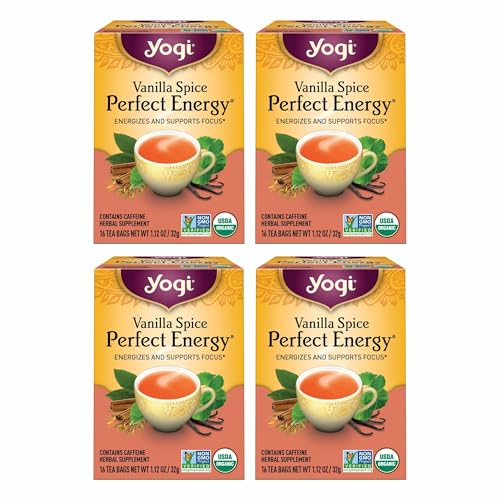
Yogi Tea Green Tea Energy Herbal Tea Bags
Green tea plus energizing botanicals for a gentler focus without the black-tea kick.
Origin & grade: USDA Organic and Non-GMO Project Verified; Yogi publishes its herb-sourcing and quality-testing standards.
This is the pick for caffeine-sensitive people who still want help focusing. The green-tea base brings L-theanine, while added yerba mate and guarana, both traditionally used as energizing plants, round out the lift. Total caffeine per bag is modest, generally in the 25-40 mg range, so it's a step down from matcha or assam by design.
Brew it with cooler water (around 175°F) to keep the green tea from turning bitter. It may support a smooth, jitter-light energy lift, though as always, it's a beverage, not a fix for genuine fatigue or poor sleep. Check current price.
- Type
- Green tea + energizing botanicals (yerba mate, guarana)
- Form
- Tea bags
- Caffeine per bag
- ~25-40 mg
- Origin
- Blend
- Certification
- USDA Organic, Non-GMO Verified
What we like
- Smooth, jitter-light energy
- Organic and Non-GMO Verified
- Good afternoon option
- Higher theanine-to-caffeine balance
Worth noting
- Lower total caffeine
- Distinct herbal-botanical taste
Who should buy it: Caffeine-sensitive people, or anyone who wants gentle, focused energy in the afternoon without a strong kick.
What we don't like: Lower caffeine than matcha or black tea; the added botanicals give it a distinct, slightly herbal flavor not everyone loves.
Bottom line: For a softer, more focused lift, Yogi Green Tea Energy blends green tea with botanicals like yerba mate, guarana, and eleuthero. The caffeine is lower than black tea or matcha, but the high theanine-to-caffeine balance of green tea makes it feel especially smooth.
07 · Best ceremonial-grade matcha
Premium Pick
Pique Sun Goddess Matcha Ceremonial Grade
A premium, lab-tested ceremonial matcha for the smoothest possible whole-leaf energy.
Origin & grade: Ceremonial grade from Kagoshima, Japan; Pique advertises Triple Toxin Screening (heavy metals, pesticides, toxic mold), a strong third-party trust signal.
Ceremonial grade is the finest, youngest-leaf matcha, prized for a naturally sweet, umami flavor you can drink straight with just water. Energy-wise it offers the same whole-leaf advantage as any matcha, roughly 60-70 mg of caffeine plus generous L-theanine per serving, but the experience is smoother and the testing is the standout.
This is a splurge, and culinary grade gives you nearly identical energy for less. But if you want the cleanest, sweetest neat-drinking matcha with best-in-class testing, Sun Goddess earns its premium. Whisk with ~175°F water; no milk needed. Check current price.
- Type
- Shade-grown green tea (ceremonial matcha)
- Form
- Stone-ground powder
- Caffeine per serving
- ~60-70 mg per 2 g
- Origin
- Kagoshima, Japan
- Certification
- Ceremonial grade, Triple Toxin Screened
What we like
- Best-in-class purity testing
- Sweet, smooth, great drunk straight
- Same whole-leaf energy as any matcha
Worth noting
- Most expensive on the list
- No energy advantage over culinary grade
Who should buy it: Daily matcha drinkers who prioritize purity testing and a sweet, smooth cup drunk straight, and don't mind paying for it.
What we don't like: The most expensive option here; the energy benefit over cheaper culinary matcha is essentially zero, you're paying for taste and testing.
Bottom line: Pique's Sun Goddess is a high-end ceremonial matcha with an unusually rigorous testing program. It's expensive, but for a daily whole-leaf energy ritual where purity and a sweet, smooth cup matter most, it's the most reassuring option here.
How we chose these energy teas
We started from the only thing that actually produces energy from tea: the caffeine-plus-L-theanine combination found in true teas (Camellia sinensis). That immediately ruled out caffeine-free herbals like peppermint, rooibos, and chamomile, they're lovely, but they can't give you a lift. From there we prioritized teas with the highest practical caffeine delivery (favoring whole-leaf matcha and robust black teas), then weighed taste, value per serving, availability on Amazon, and trust signals like organic certification and third-party testing. Every product here is something a real buyer can purchase today, and we excluded anything we couldn't verify as a genuine, in-market product.
Matcha vs. black tea vs. green energy blends: which should you pick?
Pick matcha if you want the strongest, smoothest, most sustained energy and don't mind 60 seconds of whisking, it's the most efficient caffeine-and-theanine delivery in tea. Pick a black tea (Assam or English Breakfast) if you want a familiar, no-prep morning mug with a solid caffeine hit and you take it with milk. Pick a green energy blend if caffeine makes you anxious and you'd rather have a gentle, focused lift, especially in the afternoon when you don't want to risk your sleep.
One quotable rule of thumb: gram for gram, matcha delivers roughly two to three times the energizing compounds of a steeped cup, because you drink the whole leaf instead of discarding it. That single fact explains why matcha dominates the top of nearly every tea-for-energy ranking.
A note on caffeine, timing, and your sleep
Caffeine has a half-life of several hours, which means a strong cup in the late afternoon can still be in your system at bedtime. If you're chasing energy but sleeping poorly, the most powerful move is usually to stop caffeine earlier in the day rather than to drink a stronger tea. Tea may support alertness and focus, but it works best layered on top of good sleep, not as a substitute for it. If you're pregnant, sensitive to caffeine, or managing a health condition, talk to a clinician about your daily caffeine limit before leaning on any energy tea.
Key terms
- L-theanine
- An amino acid found almost exclusively in the tea plant (Camellia sinensis). Paired with caffeine, it may support attention and a smoother, less jittery energy curve, the signature 'calm-alert' feeling of tea.
- Matcha
- Shade-grown green tea leaves stone-ground into a fine powder that is whisked into water and consumed whole, delivering far more caffeine and L-theanine per serving than steeped tea.
- Ceremonial vs. culinary grade
- Ceremonial matcha uses younger, finer leaves for a sweeter cup drunk straight; culinary grade is slightly more astringent and cheaper, ideal for lattes. Energy content is essentially the same.
- Assam
- A bold, malty black tea from northeastern India known for being one of the most robust, full-bodied common black teas, the backbone of many breakfast blends.
- Steep time
- How long tea sits in hot water. Longer steeps and hotter water extract more caffeine; for black tea, 3-5 minutes is typical for a strong, energizing cup.
Questions, answered
What tea gives you the most energy?
Matcha gives the most energy per serving because you consume the entire powdered leaf rather than steeping and discarding it. A 2-gram (1 teaspoon) serving delivers roughly 60-70 mg of caffeine plus a large dose of L-theanine, which together produce a strong but smooth lift. Among brewed teas you steep and pour off, a robust black tea like Assam is the strongest, at about 50-70 mg per cup.
Why is tea energy smoother than coffee?
True teas contain L-theanine, an amino acid that coffee lacks. When L-theanine is paired with caffeine, it may support attention and take the edge off caffeine's spike, producing a steadier 'calm-alert' feeling. Many people who get jittery or anxious from coffee tolerate tea, especially green tea and matcha, which have a higher theanine-to-caffeine ratio, much more comfortably.
Does green tea or black tea have more caffeine?
Black tea generally has more caffeine per steeped cup than green tea, roughly 40-70 mg for black versus 25-45 mg for green, depending on how you brew it. But matcha, which is a form of powdered green tea you drink whole, beats both because none of the leaf is discarded. Steep time and water temperature affect the final amount more than the tea variety does.
Is matcha better than coffee for energy and focus?
For many people, yes, not because matcha has more caffeine (a strong coffee usually has more), but because matcha's caffeine comes packaged with L-theanine. That combination may support focus while feeling smoother and less likely to cause a mid-afternoon crash or jitters. If you specifically need a very high caffeine dose, coffee still wins on raw milligrams.
How should I brew tea to get the most caffeine?
Use freshly boiled water and a longer steep for black tea, 4 to 5 minutes extracts noticeably more caffeine than a quick 1-minute dunk. For green tea and matcha, use cooler water (around 175°F / 80°C) to avoid bitterness; matcha still gives you full caffeine because you drink the whole leaf. More leaf or powder per cup also means more caffeine.
Do herbal teas like peppermint or chamomile give you energy?
No. Herbal 'teas' such as peppermint, chamomile, and rooibos contain no caffeine and no L-theanine because they aren't made from the tea plant (Camellia sinensis). They can't provide a stimulant lift. For energy you need a true tea, green, black, white, oolong, or matcha, or a blend that adds energizing botanicals like yerba mate or guarana.
Is it safe to drink energy tea every day?
For most healthy adults, moderate daily tea is fine, and many people drink one to three cups a day without issue. The main considerations are total caffeine intake and timing, too much, or too late in the day, can disrupt sleep. Tea may support alertness but is not a treatment for fatigue. If you're pregnant, caffeine-sensitive, or managing a health condition, ask a clinician about your personal caffeine limit.
Keep reading
Pique Tea Review (2026): Is It Worth It? Best & Worst Blends
Our full hands-on review of Pique, taste, value, and what to buy.
Rishi Tea Review: Organic Loose-Leaf Tested & Rated
Our full hands-on review of Rishi Tea, taste, value, and what to buy.
Tazo Tea Review (2026): Is It Worth It? The Best & Worst Blends
Our full hands-on review of Tazo, taste, value, and what to buy.
Twinings Tea Review: Is the Classic Brand Still Worth It?
Our full hands-on review of Twinings, taste, value, and what to buy.