Our pick. Harney & Sons
Check priceTwinings vs Harney & Sons: Which Tea Is Better? (2026)
The 300-year-old supermarket standard against the American whole-leaf house. One wins your wallet, the other wins the cup.
By The Best Tea Bags Desk~9 min readUpdated
Quick answer: Cup quality: Harney & Sons wins. Whole-leaf sachets brew brighter, cleaner, and more complex than Twinings' broken-leaf bags, most obviously taken black.
Our top pick.Best cup quality
Harney & Sons English Breakfast, 50 Sachets
- Price.
- $19.99 (50 sachets)
- Our rating.
- 4.7 out of 5
Our top English Breakfast for drinking black: whole-leaf China black with a clean, faintly cocoa finish.
Not sure yet? Compare all 5 picks below ↓
Short version: Harney & Sons makes the better tea, and Twinings makes the better everyday buy. Harney's whole-leaf sachets brew a cleaner, more complex, more aromatic cup than Twinings' broken-leaf bags in every category where they overlap, and its English Breakfast is our pick for drinking black in our breakfast-tea rankings. Twinings costs a third as much per cup, sits on every supermarket shelf on earth, and its Earl Grey remains the most dependable version of the world's most famous flavored tea.
This is really a comparison between two tiers that happen to share a shelf on Amazon. Twinings has blended tea on the Strand in London since 1706 and optimizes for consistency at scale: broken-leaf tea bags, familiar classics, prices that let you drink four cups a day without thinking. Harney & Sons, founded in 1983 in Millerton, New York and still family-run, packs whole and large-leaf tea into silken sachets and charges accordingly, with a catalog built on blends like its famous Hot Cinnamon Spice. Below we compare cup quality, value per cup at live verified prices, range, and availability, then name who should buy which.
The short version.
- Value per cup: Twinings wins big. Its English Breakfast runs about 12.4 cents a cup and its Earl Grey about 16 cents, versus roughly 40 cents for Harney's 50-count sachet tins.
- Signature blends: Twinings' Earl Grey is the reliable classic; Harney's Hot Cinnamon Spice is the cult favorite with real fan devotion, and its English Breakfast is our pick for drinking black.
- Availability: Twinings is everywhere; Harney lives online, in its own shops, and in better grocers.
- The honest answer: Twinings for the everyday mug, Harney for the cup you actually sit down and taste.
| Tea | Best for | Character | Cost per cup (live) |
|---|---|---|---|
| Harney & Sons English Breakfast, 50 sachets | Winner: cup quality | Refined, cocoa-edged China black | About 40 cents ($19.99 / 50) |
| Twinings English Breakfast, 100 ct | Winner: everyday value | Balanced, brisk, consistent | About 12.4 cents ($12.38 / 100) |
| Twinings Earl Grey, 100 ct | The classic flavored tea | Bright, citrus-forward bergamot | About 16 cents ($15.94 / 100) |
| Harney Hot Cinnamon Spice, 50 sachets | The cult favorite | Sweet-spicy cinnamon, no sugar | About 40 cents ($19.99 / 50) |
| Yorkshire Gold, 160 ct | Strong third option | Malty, rounded, milk-first | About 9.6 cents ($15.37 / 160) |
Twinings vs Harney & Sons at a glance, live Amazon prices verified July 22, 2026
Harney & Sons English Breakfast, 50 Sachets
Harney & Sons
Our top English Breakfast for drinking black: whole-leaf China black with a clean, faintly cocoa finish.
Bottom line: This is the cup that defines the quality gap between these brands. Taken black, whole-leaf China black tea like this is more complex and better balanced than anything Twinings bags.
Origin and grade. 100% China black tea in whole-leaf silken sachets; family company, Millerton NY, founded 1983.
Harney builds its English Breakfast in the original tradition, 100% Chinese black tea, and that sets it apart from a supermarket blend: a clean, slightly sweet, almost cocoa-like depth alongside the expected briskness, and a cup that stays bright rather than turning tannic as it cools.
The price is the catch: at $19.99 for 50 sachets you are paying about 40 cents a cup, three times Twinings. For a four-cup-a-day habit that is real money; for one proper morning cup, it is worth it. Our full Harney & Sons review covers the wider catalog.
Who should buy it.
Drinkers who take tea black or lightly and want the best-tasting breakfast cup at any mainstream price.
What we don't like.
Around three times Twinings' cost per cup, and silken sachets are less eco-friendly than paper bags.
- Type
- 100% China black tea
- Form
- Whole-leaf silken sachets
- Caffeine
- Full caffeine
- Origin
- China; blended in Millerton, NY
- Count
- 50 sachets
What we like.
- Our top breakfast tea for drinking black
- Whole-leaf sachets steep clean
- Excellent black or with milk
- Also sold loose for better value
Worth noting.
- About 40 cents a cup
- Sachets are plastic-adjacent

Twinings English Breakfast Black Tea, 100 Count
Twinings
The dependable classic at about 12 cents a cup: balanced, brisk, and nearly impossible to ruin.
Bottom line: The default everyday English Breakfast. It cannot match Harney's depth, but it is a third of the price, consistent box after box, and available in any store in any town.
Origin and grade. Blended by Twinings of London, established 1706; Rainforest Alliance sourcing.
Twinings' English Breakfast is the blend most people picture when they hear the name: a balanced, medium-bodied, Ceylon-forward cup with a clean finish and zero surprises. It takes milk gracefully, forgives an over-steep better than most, and tastes the same whether you buy it in London, Lagos, or Louisville.
Broken-leaf bag grade is the ceiling: next to Harney's whole leaf it reads simpler and shorter. But as the everyday workhorse, it is exactly right. Full verdict in our Twinings review.
Who should buy it.
Anyone who wants a reliable daily breakfast tea at supermarket price and availability.
What we don't like.
Noticeably less depth and aroma than Harney's whole-leaf sachets, and slightly thin for heavy-cup drinkers.
- Type
- Black tea blend, Ceylon-forward
- Form
- Tea bags
- Caffeine
- Full caffeine
- Certification
- Rainforest Alliance sourcing
- Count
- 100 bags
What we like.
- About 12.4 cents a cup
- Available everywhere
- Very consistent
- Hard to over-brew
Worth noting.
- Broken-leaf depth ceiling
- Simpler cup than Harney

Twinings Earl Grey Tea, 100 Count
Twinings
The benchmark Earl Grey: bright, citrus-forward bergamot that avoids the soapy trap, everywhere, always.
Bottom line: If Twinings wins you over, this is the blend that does it. The house that claims Earl Grey's original recipe still makes the most dependable everyday version of it.
Origin and grade. Rainforest Alliance Certified sourcing; black tea with natural bergamot flavoring.
Earl Grey lives or dies on its bergamot, and Twinings clearly spends its blending skill here. The aroma is citrus-forward and floral rather than flat or candied, the black-tea base stays present under the citrus, and the cup works black, with milk, or with lemon. Twinings has blended Earl Grey since the 1830s and maintains the recipe was created for Charles Grey, the 2nd Earl himself.
Purists will note it uses natural bergamot flavoring rather than pressed oil, and broken-leaf grade limits its depth. For an everyday Earl Grey, neither matters much.
Who should buy it.
Earl Grey drinkers who want the dependable classic at a supermarket price.
What we don't like.
Flavoring rather than bergamot oil, and less depth than whole-leaf versions.
- Type
- Flavored black tea
- Form
- Tea bags
- Caffeine
- Full caffeine
- Certification
- Rainforest Alliance sourcing
- Count
- 100 bags
What we like.
- Benchmark bergamot balance
- About 16 cents a cup
- Works black, milk, or lemon
Worth noting.
- Natural flavoring, not pressed oil
- Broken-leaf grade
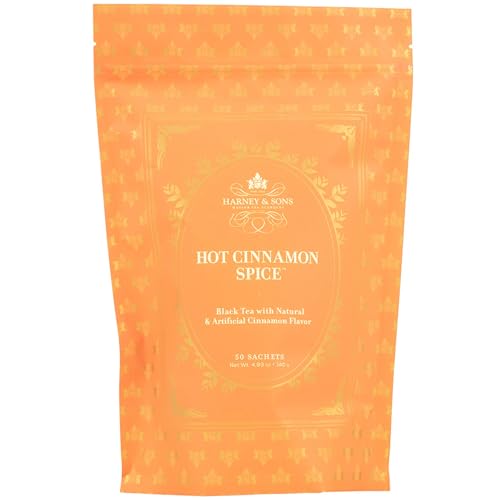
Harney & Sons Hot Cinnamon Spice, 50 Sachets
Harney & Sons
The blend with a fandom: three cinnamons, orange peel, and cloves over black tea, sweet-tasting with zero sugar.
Bottom line: Twinings has nothing like this. Hot Cinnamon Spice is Harney's signature and one of the most re-ordered teas in America, a naturally sweet-reading spice bomb that converts people who think they do not like tea.
Origin and grade. Black tea blended with three types of cinnamon, orange peel, and sweet cloves; no added sugar.
Every brand has a flagship; Harney has a phenomenon. Hot Cinnamon Spice layers three cinnamons, orange peel, and sweet cloves over a black-tea base, and the result reads dessert-sweet despite containing no sugar at all. It is often credited with converting coffee drinkers and soda habits.
It is assertive, you will not sip it absent-mindedly, and at about 40 cents a cup it is an indulgence. But as the tea that shows what Harney does that Twinings cannot, it is the perfect exhibit.
Who should buy it.
Anyone who likes bold flavored teas, wants sweetness without sugar, or is buying a first Harney tin to see what the fuss is about.
What we don't like.
Too assertive for an all-day tea, and the spice profile is love-it-or-leave-it.
- Type
- Flavored black tea
- Form
- Whole-leaf silken sachets
- Caffeine
- Full caffeine
- Sweetener
- None (naturally sweet-reading)
- Count
- 50 sachets
What we like.
- Genuinely unique signature blend
- Sweet flavor with zero sugar
- Great hot or iced
Worth noting.
- About 40 cents a cup
- Polarizing spice intensity
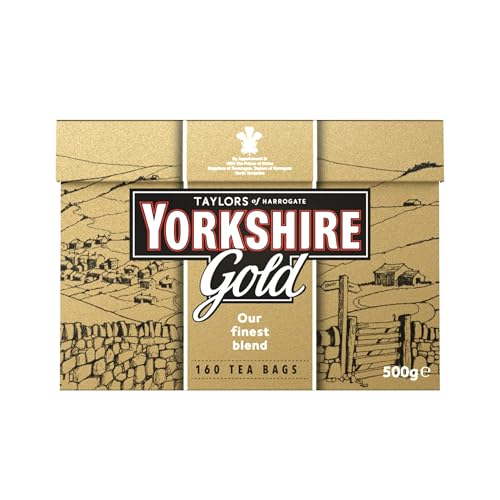
Taylors of Harrogate Yorkshire Gold, 160 Count
Yorkshire Tea
The middle path: a premium-tasting, malty, milk-first blend at Twinings money, and our overall breakfast-tea winner.
Bottom line: If Harney's quality tempts you but the per-cup price stings, Yorkshire Gold is the strongest third option: a clear step up from Twinings in body and roundness at nearly the same cost per cup.
Origin and grade. Rainforest Alliance Certified; blended from Assam, East African, and Sri Lankan teas in Harrogate.
The gap between 12-cent Twinings and 40-cent Harney is wide, and Yorkshire Gold lives right in it, at about 11.7 cents a cup. It is a rounder, maltier, more layered cup than Twinings English Breakfast, the rare tea built to be better with milk than without, and it won our breakfast-tea rankings outright.
Black-tea purists should still stretch to Harney; the whole-leaf brightness is something bag-grade blends cannot fake.
Who should buy it.
Milk-first drinkers who want a premium-tasting daily cup without Harney's per-cup price.
What we don't like.
Not the answer for black-tea purists, and it is a bags-only, milk-first sort of blend.
- Type
- Black tea blend
- Origin
- Assam, East Africa, Sri Lanka
- Caffeine
- Full caffeine
- Certification
- Rainforest Alliance
- Count
- 160 bags
What we like.
- Our top-ranked breakfast tea
- About 11.7 cents a cup
- Superb with milk
Worth noting.
- Less refined than Harney taken black
- Milk-first character
Cup quality: whole leaf tells
The structural difference decides this category before the kettle boils. Twinings fills its bags with broken-leaf grade tea, which extracts fast and consistently but trades away aroma and complexity. Harney packs whole and large-leaf tea into roomy sachets, and the leaf has space to unfurl and give up its full character.
Whole leaf versus broken leaf plays out predictably: Harney's English Breakfast is brighter, deeper, and longer on the finish than Twinings', and the gap is widest taken black, where there is no milk to hide behind. Even in flavored territory, Harney's blends carry more dimension, though Twinings' Earl Grey remains impressively well-balanced for its tier.
Verdict: Harney & Sons, in every overlapping category. The question is only whether the difference is worth 3x per cup to you.
Value per cup: Twinings by a mile
The live math, verified July 22, 2026: Twinings English Breakfast is $12.38 for 100 bags (12.4 cents a cup) and Earl Grey is $15.94 for 100 (about 16 cents). Harney's 50-sachet tins run $19.99, which is about 40 cents a cup. Against the 27.9 cent median of our 162-tea price index, Twinings sits comfortably below and Harney comfortably above.
Frame it as a habit: four cups a day for a year costs about $180 with Twinings and about $580 with Harney. That is the whole argument for keeping both brands in the cupboard, Twinings for volume, Harney for the cup you slow down for. One softener: Harney's loose-leaf tins price out meaningfully cheaper per cup than its sachets if you own an infuser.
Verdict: Twinings, decisively.
Range and availability: different games
Twinings plays everywhere-ball. Its classics, Earl Grey, Lady Grey, English and Irish Breakfast, greens, herbals, are stocked in practically every supermarket on the planet, and replacement is never more than a corner store away.
Harney plays depth-ball. Its catalog runs to hundreds of teas, from the cult Hot Cinnamon Spice to single-estate lots and serious jasmines, but you will mostly buy it online or from better grocers. That trade shapes what each brand is for: Twinings is infrastructure, Harney is a destination.
Verdict: Twinings for reach, Harney for range depth. Call it a draw that depends on which you value.
Which should you buy?
Buy Twinings if tea is a several-times-daily habit and you want dependable classics at 12 to 16 cents a cup from any store anywhere. The English Breakfast 100-count and Earl Grey 100-count are the value plays.
Buy Harney & Sons if you drink fewer, better cups, take your tea black, or want blends with real character. Start with the English Breakfast sachets or the Hot Cinnamon Spice, and graduate to loose tins for better per-cup math.
Buy Yorkshire Gold if you take milk and want premium body at Twinings money.
The honest answer for most people: Twinings as the weekday workhorse, one Harney tin for the weekend cup. The combined habit still costs less than a daily coffee-shop visit.
Questions, answered.
Is Harney and Sons better than Twinings?
On cup quality, yes. Harney's whole-leaf sachets brew a brighter, more complex cup than Twinings' broken-leaf bags, and its English Breakfast is our pick for drinking black in our breakfast-tea rankings. Twinings wins on price at about 12 to 16 cents a cup versus Harney's 40, and on availability, since it is stocked in nearly every supermarket on earth.
Why is Harney and Sons more expensive than Twinings?
Leaf grade and format. Harney packs whole and large-leaf tea into roomy silken sachets, which costs more than the broken-leaf grade Twinings uses in standard bags, and it blends in smaller batches. At live prices that works out to about 40 cents a cup for Harney's 50-sachet tins versus about 12.4 cents for Twinings English Breakfast.
Which has the better Earl Grey, Twinings or Harney and Sons?
Twinings is the better everyday buy: its Earl Grey is the benchmark supermarket version, bright and balanced at about 16 cents a cup. Harney's Earl Grey teas are finer, with more depth from whole-leaf grade, but at well over double the per-cup cost. Daily drinker: Twinings. Weekend cup or gift: Harney.
What is Harney and Sons' most popular tea?
Hot Cinnamon Spice is the brand's signature: a black tea blended with three types of cinnamon, orange peel, and sweet cloves that tastes sweet despite containing no sugar. It has a genuine cult following and is the tin we most often recommend as a first Harney purchase, alongside the English Breakfast sachets.
Is Twinings tea good quality?
For its tier, yes. Twinings is consistent, well-blended, broken-leaf bag tea with three centuries of blending behind it and Rainforest Alliance sourcing on its classics. It cannot match whole-leaf brands like Harney and Sons on depth or aroma, but as an everyday supermarket tea it is one of the most reliable choices in the world.
Filed under Comparison
Part of Tea Brand Reviews
More tea worth comparing
Whatever you decide, these are the tea bags our reviews keep ranking on top. Live price check on each.
- Check price
Best Overall.
Twinings English Breakfast - Check price

- Check price

Best Fast Brew.
PG Tips Original - Check price

- Check price

- Check price

Best Green.
Ito En Oi Ocha Green Tea
As an Amazon Associate we earn from qualifying purchases, at no cost to you.
Keep reading.
Harney & Sons Tea Review
Our full verdict on the Millerton house and its best tins.
Twinings Tea Review
How the supermarket classics hold up, blend by blend.
Twinings Alternatives
Ready to trade up from Twinings? Ranked switches worth making.
Best English Breakfast Tea
Where Harney's sachets and Twinings' bags both landed in our rankings.
Tea Bag Price Index (July 2026)
Live cost-per-cup data for 162 verified teas, including both brands.