Our pick. Rishi Tea
Check priceRishi Tea vs Art of Tea: Which Premium Brand Wins? (2026)
Two organic loose-leaf darlings, two different philosophies. One is a single-origin purist from Milwaukee; the other a Los Angeles blend house. Here's who should buy which.
By The Best Tea Bags Desk~8 min readUpdated
Quick answer: Rishi = single-origin purist. Direct-trade sourcing, botanical and unblended focus, the cup tastes like its origin. Best if you want to learn what a region's tea actually tastes like.
Our top pick.Best pick to judge Rishi if you want their purist take on a classic
Rishi Tea Organic Earl Grey Loose Leaf Tea
- Price.
- $21.00
- Our rating.
- 4.7 out of 5
Rishi's restraint in a teacup: a clean Ceylon base with bergamot that whispers instead of shouts, the purist's Earl Grey.
Not sure yet? Compare all 2 picks below ↓
Short version: If you care most about tasting a single, clearly-sourced tea the way the garden made it, a Yunnan black, a sencha, a botanical tisane, Rishi is your brand. If you want artful, aromatic blends that make an everyday cup feel like a treat, Art of Tea is the one. Both are genuinely organic, both are a real step up from the grocery aisle, and honestly, most serious tea drinkers end up with a tin of each.
These two get compared constantly, and the comparison is a little unfair to both, because they aren't really trying to do the same thing. Rishi Tea, out of Milwaukee, built its name on direct-trade, single-origin sourcing and botanical purism, it's the brand cafes and restaurants reach for when they want the tea to taste like the place it came from. Art of Tea, out of Los Angeles, grew out of custom and foodservice blending, and its strength is the blend: bergamot layered over a brisk black, signature house mixes, the kind of cup that's engineered to be delicious rather than to be a teaching example.
We compared both ranges on sourcing, certification, leaf grade, price per cup, and buyer reviews. Below is the honest split, sourcing, blend artistry versus single-origin, loose leaf versus sachet, price, and a clear “pick this one if…” at the end.
The short version.
- Art of Tea = blend artist. Aromatic, forgiving, signature mixes like Earl Greyer. Best if you want a reliably delicious everyday cup with no fuss.
- Both are certified USDA Organic and both use whole or full leaf, not the dust you find in supermarket bags.
- Format: Rishi offers serious loose leaf and well-made sachets (great for offices and cafes). Art of Tea leans loose leaf, with whole-leaf pyramid sachets available.
- On price, they're close. Per-cup cost on both lands in “reasonable for premium” territory once you account for how little leaf each cup needs and how well whole leaf re-steeps.
- If you only buy one tin to judge each brand: a single-origin black or green from Rishi, and Earl Greyer from Art of Tea.
| Rishi | Art of Tea | |
|---|---|---|
| Home base | Milwaukee, WI | Los Angeles, CA |
| Core identity | Direct-trade, single-origin & botanical purist | Organic blend house, custom/foodservice roots |
| Best at | Unblended single-origins, botanicals, tisanes | Signature blends, flavored blacks, aromatic mixes |
| Organic | USDA Organic | USDA Organic |
| Leaf grade | Full / whole leaf | Whole leaf |
| Formats | Loose leaf + sachets (strong cafe presence) | Loose leaf + whole-leaf pyramid sachets |
| Signature pick | Single-origin blacks & greens (also a clean Earl Grey) | Earl Greyer |
| Who it suits | Drinkers who want origin transparency & purity | Drinkers who want a delicious, forgiving everyday cup |
Rishi Tea vs Art of Tea at a glance
Rishi Tea Organic Earl Grey Loose Leaf Tea
Rishi Tea
Rishi's restraint in a teacup: a clean Ceylon base with bergamot that whispers instead of shouts, the purist's Earl Grey.
Bottom line: The clearest window into Rishi's whole philosophy. The base tea is so good it could stand alone, and the bergamot is dialed back to let it. If you find most Earl Greys too perfumey, this is the one to try, and the best single tin to decide whether Rishi is for you.
Origin and grade. USDA Organic certified; black tea base sourced from Sri Lanka (Ceylon), scented with bergamot oil rather than artificial flavoring.
Earl Grey is the tea most often ruined by heavy-handed flavoring, soapy, perfumey cups that taste more like cologne than tea. Rishi avoids that trap, and it's instructive how they avoid it. True to the brand's single-origin instincts, the base is a full-leaf Ceylon black that brews a clear amber liquor with real backbone, and because it is scented with bergamot oil rather than artificial flavoring, the citrus is restrained rather than perfumey. A Ceylon base like this typically holds up to a splash of milk without collapsing into nothing.
Brew it at roughly 95°C (just off the boil) for 3-4 minutes. Push past five minutes and the Ceylon tannins turn brisk, pleasant if you take milk, sharp if you don't. At a few grams per cup, a tin lasts a long time, which softens the premium price on a per-cup basis. If you want a more bergamot-forward, aromatic Earl Grey, see Art of Tea's Earl Greyer below, that's the whole difference between these two brands in a single cup.
Who should buy it.
Daily black-tea drinkers who want an organic Earl Grey that tastes like tea first and bergamot second, and who take it either straight or with milk. Also the right starting tin if you're trying to decide whether Rishi's purist approach is for you.
What we don't like.
It can tip brisk if oversteeped, and like all of Rishi's range it costs noticeably more per ounce than a supermarket Earl Grey. If you actively want a louder, more aromatic cup, this restraint may read as understated.
- Type
- Flavored black tea
- Form
- Loose leaf, full leaf
- Caffeine
- Moderate (black tea base)
- Origin
- Sri Lanka (Ceylon)
- Certification
- USDA Organic
- Brew
- 95°C, 3-4 min
What we like.
- Real bergamot scent, not soapy or synthetic
- Clean full-leaf Ceylon base with genuine body
- Holds up well with milk
- USDA Organic
Worth noting.
- Turns brisk if oversteeped
- Premium price vs grocery Earl Grey
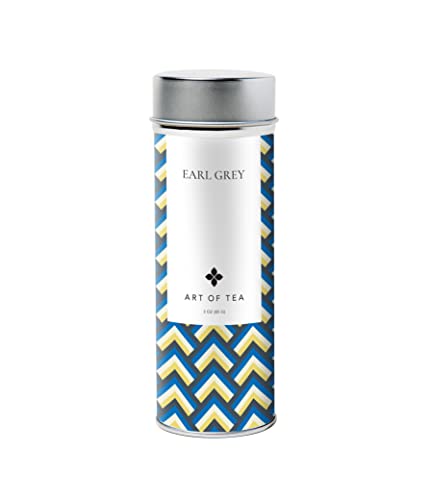
Art of Tea Earl Greyer Organic Loose Leaf Tea
Art of Tea
Art of Tea's blending instinct in one tin: bergamot-forward, brightly aromatic, and built to be delicious rather than instructive.
Bottom line: The blend that best shows what Art of Tea does that Rishi doesn't. The bergamot is bright and present without turning soapy, the whole-leaf base gives a clean cup with real body, and the whole thing is engineered to please rather than teach. The clearest single tin to decide if the brand is for you.
Origin and grade. USDA Organic certified; whole-leaf organic black tea scented with bergamot oil and finished with blue cornflower petals.
Earl Grey is the ultimate test of a flavored-black blender because the failure modes are so easy to hit: too little bergamot and it's just mediocre black tea, too much (or low-quality oil) and it tastes like perfume or dish soap. Earl Greyer is built to thread that needle: real bergamot oil on a whole-leaf base, so the citrus is meant to read as fresh zest rather than synthetic, sitting on top of a brisk, malty black base instead of fighting it. Where Rishi pulls the citrus back to spotlight the leaf, Art of Tea pushes it forward on purpose, and the result is unapologetically aromatic.
The blue cornflower petals are mostly cosmetic, they look beautiful in the tin and add negligible flavor, but they're a real botanical, not a dye, which fits the brand's organic positioning. A standard 3-ounce tin yields roughly 40 to 45 cups at a heaped teaspoon per 8 ounces, and the whole leaf re-steeps well for a lighter second cup. Run the math and the per-cup cost lands in genuinely reasonable territory for something this aromatic.
If you only try one Art of Tea blend to decide whether the brand is for you, make it this one. It's the clearest demonstration of what the extra money buys, and the cleanest contrast with Rishi's purist Earl Grey above.
Who should buy it.
Anyone who drinks Earl Grey regularly and has only ever had the bagged version, or who wants a brighter, more aromatic cup than Rishi's restrained take. The upgrade is immediately obvious and the per-cup cost stays sane.
What we don't like.
The cornflower petals are pure decoration. And like all bergamot teas, it's polarizing, if you find Earl Grey perfumey in general, a brighter, more assertive bergamot won't change your mind.
- Type
- Flavored black tea
- Form
- Whole loose leaf
- Certification
- USDA Organic
- Key inclusions
- Bergamot oil, blue cornflower petals
- Caffeine
- Moderate (black tea base)
- Approx. cups per 3 oz tin
- 40-45
What we like.
- Bright, fresh bergamot that avoids the soapy trap
- Whole-leaf organic base with real body
- Forgiving of over-steeping
- Strong per-cup value among premium Earl Greys
Worth noting.
- Cornflower petals add looks, not flavor
- Bergamot intensity won't convert Earl Grey skeptics
Sourcing & organic: two honest brands, two different stories
Both brands are certified USDA Organic, so on the baseline question, is this clean tea?, they're even. Where they diverge is what they emphasize. Rishi built its reputation on direct-trade relationships and single-origin transparency: the brand wants you to know the region, often the garden, and to taste the tea the way that place produces it. That's why Rishi's catalog is full of named origins and unblended teas, a Yunnan, a Ceylon, a Japanese green, rather than clever mixes.
Art of Tea comes at organic from the blender's side. Its roots are in custom and foodservice blending, so the sourcing serves the blend: the goal is a consistent, delicious, repeatable cup, and the organic certification is the floor it builds on rather than the headline. Neither approach is “more organic” than the other. They're just answering different questions, where is this from? versus how good can we make this taste?
Blend artistry vs single-origin purism
This is the real fork in the road. Rishi rewards curiosity. If you want to understand what a Himalayan black tastes like next to a Chinese one, or to drink a botanical tisane that's actually built from quality whole botanicals, Rishi is the better teacher. Even its flavored teas, like the Earl Grey above, lead with the leaf and treat flavoring as a light touch.
Art of Tea rewards appetite. Its signature blends, Earl Greyer chief among them, are engineered to be immediately, reliably delicious. The bergamot is brighter, the mixes are more aromatic, and the cup is more forgiving when you don't fuss over it. You're not paying to learn; you're paying to enjoy.
Format: loose leaf vs sachet
Both brands lead with loose leaf and both use whole or full leaf rather than the broken dust inside most supermarket bags, so the floor is high on either side. The practical difference is breadth.
Rishi has an unusually strong sachet program, which is a big part of why you see the brand in so many cafes, hotels, and restaurants, a Rishi sachet delivers far more of the loose-leaf experience than a typical teabag, which makes it the easy choice for an office or a kitchen where someone doesn't want to measure leaf and time a steep. Art of Tea also offers whole-leaf pyramid sachets, but its center of gravity is the loose-leaf tin.
If you want the ritual, weighing leaf, watching it unfurl, re-steeping, go loose leaf with either brand. If you want premium tea with zero ceremony for a shared space, Rishi's sachets are the more battle-tested option.
Price & value: closer than you'd think
Both sit well above grocery-store pricing and roughly in line with each other. The honest framing isn't sticker price, it's cost per cup. Premium whole-leaf and full-leaf teas use only a few grams per cup, a tin lasts a long time, and good whole leaf re-steeps for a lighter second cup. Once you account for that, both brands land in genuinely reasonable per-cup territory for what they are.
If you want to squeeze maximum value: lean toward Rishi's single-origins (you're paying for the leaf, not the blend work) and toward Art of Tea's signature blends (where the blending is the value you can't easily replicate at home). Buying a single-origin from a blend house, or a complex blend from a purist, is paying for the thing each brand isn't best at.
The verdict: pick this one if…
Pick Rishi if you want origin transparency, you like drinking single-origin teas unblended, you're curious about how regions differ, you want a restrained hand with flavored teas, or you need premium-quality sachets for an office or cafe.
Pick Art of Tea if you want aromatic, reliably delicious blends, you're upgrading from bagged supermarket tea and want the difference to be obvious, you don't want to fuss over steep times, or Earl Greyer-style flavored teas are your everyday cup.
And honestly? If tea is becoming a real part of your routine, buy one tin from each, a single-origin black or green from Rishi, and Earl Greyer from Art of Tea. That pairing teaches you more about your own taste than any review can, and it's how many loose-leaf drinkers end up with both brands in the cupboard.
Questions, answered.
Is Rishi or Art of Tea better for beginners?
Art of Tea is the gentler on-ramp. Its blends are aromatic, forgiving of imprecise brewing, and the upgrade from bagged supermarket tea is immediately obvious, start with Earl Greyer. Rishi is better once you're curious about why teas taste different, because its single-origin range is built to show off the differences between regions.
Are both brands actually organic?
Yes. Both Rishi and Art of Tea carry USDA Organic certification across the products compared here. The difference isn't whether they're organic, it's what each brand emphasizes: Rishi foregrounds direct-trade single-origin sourcing, while Art of Tea foregrounds the quality of its blends.
Does Rishi or Art of Tea offer tea bags or sachets?
Both do, with whole or full leaf rather than dust. Rishi has an especially strong sachet program, it's why you see the brand in so many cafes and hotels, making it the easier pick for offices or shared kitchens. Art of Tea offers whole-leaf pyramid sachets too, but leans more toward loose-leaf tins.
Which brand is better value per cup?
They're close. Both use only a few grams of whole or full leaf per cup, so a tin lasts a long time and good leaf re-steeps for a second cup, which makes the per-cup cost reasonable on both. For best value, buy what each brand does best: single-origins from Rishi, signature blends like Earl Greyer from Art of Tea.
Should I just buy both?
If tea is becoming a regular habit, yes, and most serious drinkers do. A single-origin from Rishi plus Earl Greyer from Art of Tea covers both ends of the spectrum: the purist origin cup and the aromatic everyday blend. That pairing tells you more about your own preferences than any single tin can.
Filed under Comparison
Part of Tea Brand Reviews
More tea worth comparing
Whatever you decide, these are the tea bags our reviews keep ranking on top. Live price check on each.
- Check price

Best Overall.
Twinings English Breakfast - Check price

- Check price

Best Fast Brew.
PG Tips Original - Check price

- Check price

- Check price

Best Green.
Ito En Oi Ocha Green Tea
As an Amazon Associate we earn from qualifying purchases, at no cost to you.
Keep reading.
Rishi Tea Review
Our full take on the Milwaukee direct-trade brand, the single-origins, the sachets, and what's worth your money.
Art of Tea Review
The LA blend house up close: Earl Greyer, the signature mixes, and whether the premium holds up.
The Best Loose Leaf Tea
Our broader roundup of the loose-leaf teas worth buying, across black, green, oolong, and herbal.