Our Pick: Organic India
Check price →Organic India Tea Review (2026): Is It Worth It? Best & Worst Tulsi Blends
Organic India built its name on tulsi (holy basil), and after weeks living with the lineup we found a brand that's unusually serious about sourcing, Fairtrade, regenerative-organic, Non-GMO, but whose herb-forward, clove-and-basil flavor is a genuine acquired taste. Here's which blends are worth it and which to skip.
By Justin Park · 13 min read · 2026-06-14
★ Our Top Pick
Best Organic India Tea Overall (Most Approachable)

The friendliest way into tulsi, bright lemon and warming ginger soften holy basil's savory edge into a genuinely easy daily cup.
Not sure yet? Compare all 6 picks below ↓
Short answer: yes, Organic India tea is worth it, if you actually want tulsi. Organic India is a tulsi (holy basil) specialist, not a general tea company, and that focus is its whole personality. Nearly every blend is USDA Certified Organic and Non-GMO, much of the tulsi is Fairtrade and Regenerative Organic Certified, and a box of 18 bags typically runs $4 to $7, which makes it one of the few brands offering genuinely traceable, regeneratively-farmed botanicals at grocery-shelf prices. If you want a soothing, adaptogen-style cup with a clear sense of where the leaves came from, Organic India delivers better than almost anyone. If you're chasing a crisp single-origin green or a brisk breakfast black, this isn't your brand.
The trade-off is flavor. Tulsi has a distinctive savory-herbal, faintly clove-and-pepper character that's nothing like ordinary tea, and Organic India leans into it. Newcomers often describe the Original blend as 'soapy' or 'medicinal' on the first cup; tulsi devotees find it grounding and crave it. That love-it-or-leave-it quality is the single biggest variable in whether you'll keep the box around. The good news is the brand blends tulsi with familiar flavors, lemon ginger, green tea, turmeric, that make it far more approachable, and those are where most people should start.
After working through Organic India's best-selling tulsi blends, our overall pick for most people is Organic India Tulsi Lemon Ginger, it's the friendliest on-ramp to tulsi, it tastes genuinely good, and it's cheap enough to drink daily. Below we break down six flagship blends, name the standouts and the duds, explain who each is really for, and point you to where to buy. One thing we won't do: claim any of these teas treat, cure, or detox anything. Tulsi is an adaptogen traditionally used in Ayurveda for stress and calm, these are soothing rituals, not medicine.
The short version
- Organic India is a tulsi (holy basil) specialist, its entire identity is built on adaptogenic herbal blends, not on conventional black or green tea, so judge it as a wellness-tea brand.
- Our overall pick is Organic India Tulsi Lemon Ginger; it's the most approachable, crowd-pleasing entry to tulsi and pleasant enough to drink every day.
- Sourcing is the standout: much of Organic India's tulsi is Fairtrade and Regenerative Organic Certified, and nearly the whole line is USDA Organic and Non-GMO, rare traceability for a tea you can buy for under $7 a box.
- Plain tulsi is an acquired taste: the Original blend's savory, clove-pepper, faintly medicinal profile is the brand's biggest love-it-or-hate-it variable, so most newcomers should start with a flavored blend.
- Treat 'Sleep,' 'Tulsi Cleanse,' and adaptogen language as traditional-use framing, not medical claims, tulsi and ashwagandha are herbs traditionally used for calm and stress, and several can interact with medications, so check the box and ask a clinician before daily use.
| Blend | Type | Best for | Caffeine |
|---|---|---|---|
| Tulsi Lemon Ginger | Herbal | Most approachable everyday cup (overall pick) | Caffeine-free |
| Tulsi Original | Herbal | Purest holy basil (acquired taste) | Caffeine-free |
| Tulsi Green Tea | Green | Smooth, forgiving green with a light lift | Light caffeine |
| Tulsi Sleep | Herbal | Calming bedtime wind-down ritual | Caffeine-free |
| Tulsi Turmeric Ginger | Herbal | Warming, golden-tea-style cup | Caffeine-free |
| Tulsi Ashwagandha | Herbal | Earthy daytime adaptogen ritual | Caffeine-free |
Organic India tulsi lineup at a glance, our six tested flagship blends, what each is best for, and caffeine status.
01 · Best Organic India Tea Overall (Most Approachable)
Top PickOrganic India Tulsi Lemon Ginger Tea
The friendliest way into tulsi, bright lemon and warming ginger soften holy basil's savory edge into a genuinely easy daily cup.
Origin & grade: USDA Certified Organic and Non-GMO; tulsi sourced from Organic India's certified-organic farms in India.
Organic India Tulsi Lemon Ginger is the blend we'd hand anyone curious about tulsi. It pairs the brand's signature Rama, Krishna and Vana holy basil with organic lemongrass, lemon peel and ginger, so the savory, clove-ish edge of plain tulsi gets wrapped in bright citrus and gentle warmth. The result is lively, lightly zingy, and far more familiar-tasting than Original tulsi, the kind of cup that pleases a whole household.
Steep 5-7 minutes for the fullest body; it takes honey beautifully if you want more sweetness. At roughly $5 a box of 18, less in multipacks, it's an easy pantry staple. If you like it, the same idea shows up in the caffeinated Tulsi Green Tea Lemon Ginger, which adds a light lift.
- Type
- Herbal (caffeine-free)
- Count
- 18 tea bags
- Key botanicals
- Rama/Krishna/Vana Tulsi, Lemongrass, Lemon Peel, Ginger
- Certifications
- USDA Organic, Non-GMO
What we like
- Most approachable entry to tulsi
- Bright, warming, crowd-pleasing flavor
- Caffeine-free
- Organic and Non-GMO; under ~$5 a box
Worth noting
- Ginger is gentle, not fiery
- Tulsi backbone still present for the herb-averse
Who should buy it: Tulsi-curious beginners, and anyone who wants a bright, warming, caffeine-free everyday cup that the whole household will drink.
What we don't like: If you want fiery, fresh-grated ginger intensity, this is gentler than that. Tulsi's herbal backbone is still present, so true tulsi-haters won't be fully converted.
Bottom line: If you buy one Organic India tea, make it this one. Lemon Ginger is the blend that converts tulsi skeptics: the citrus-and-ginger frame makes the holy basil approachable instead of medicinal, and it's cheap enough to drink daily.
02 · Best Pure Tulsi (Acquired Taste)
Purist Pick
Organic India Tulsi Original Tea
The brand's flagship and its truest expression of holy basil, grounding and savory to devotees, soapy and medicinal to newcomers.
Origin & grade: USDA Certified Organic and Non-GMO; signature Rama, Krishna and Vana tulsi blend.
Organic India Tulsi Original is the blend the whole brand is built on. It's a pure three-tulsi infusion, Rama (sweet, clove-like), Krishna (peppery), and Vana (lemony, wild) holy basil, with nothing else to hide behind. To tulsi devotees it's grounding, savory and faintly sweet, the herbal equivalent of a deep breath. To newcomers it can read as soapy, medicinal, or oddly savory on the first cup.
This is the one to judge the brand's sourcing on: Original is where Organic India's Fairtrade, regeneratively-farmed tulsi speaks for itself. We'd just steer first-timers to Lemon Ginger or the Green Tea blend before working up to Original, drunk on its own terms, it's a 4-plus, but it loses a point for how steep the learning curve is.
- Type
- Herbal (caffeine-free)
- Count
- 18 tea bags
- Key botanicals
- Rama Tulsi, Krishna Tulsi, Vana Tulsi (holy basil)
- Certifications
- USDA Organic, Non-GMO
What we like
- Purest expression of tulsi
- Showcases the brand's standout sourcing
- Caffeine-free
- Organic and Non-GMO
Worth noting
- Strong acquired taste, soapy/medicinal to some
- Too herbal for tulsi newcomers
Who should buy it: Established tulsi fans who want the purest, additive-free holy basil cup, and anyone using it as a calming, caffeine-free evening ritual.
What we don't like: Genuinely an acquired taste, the savory, faintly medicinal profile turns off a lot of newcomers. There's nowhere to hide if you don't like tulsi itself.
Bottom line: The definitive tulsi cup, and the one that most divides people. If you already love holy basil, this is the cleanest, most direct version. If you're new to it, start with a flavored blend first, Original is the deep end.
03 · Best Organic India Green Tea (Light Caffeine)
Best Green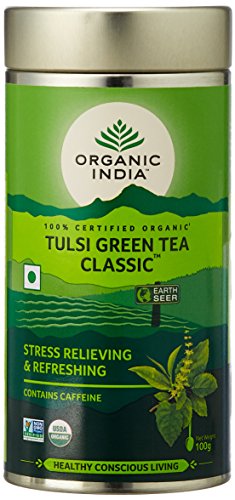
Organic India Tulsi Green Tea
Tulsi blended with Darjeeling green tea, a smooth, lightly caffeinated cup that tames green tea's bitterness with holy basil's roundness.
Origin & grade: USDA Certified Organic and Non-GMO; tulsi blended with premium Darjeeling green tea.
Organic India Tulsi Green Tea blends the three-tulsi base with premium Darjeeling green tea, giving you a smooth, mellow cup with a light caffeine lift (a fraction of a coffee's). The holy basil softens green tea's grassy astringency, so this is noticeably more forgiving than a bare sencha, it doesn't go bitter and tannic if you forget the bag in the mug.
It's our pick for the morning or early-afternoon Organic India cup precisely because it's so easy-drinking. Steep 2-4 minutes with water just off the boil to keep it sweet. Purists chasing a clean, single-origin grassy green should look elsewhere, the tulsi is always present, but as an everyday, no-fuss green, it's a winner. A Tulsi Green Tea Lemon Ginger variant adds citrus if you want it.
- Type
- Green tea (lightly caffeinated)
- Count
- 18 tea bags
- Key botanicals
- Rama/Krishna/Vana Tulsi, Darjeeling Green Tea
- Certifications
- USDA Organic, Non-GMO
What we like
- Smooth, forgiving green, won't go bitter
- Light caffeine lift
- Tulsi rounds off astringency
- Organic and Non-GMO
Worth noting
- Not a clean single-origin green
- Caffeine is modest
Who should buy it: People who want a smooth, forgiving green tea with a light caffeine lift and don't mind a gentle herbal note from the tulsi.
What we don't like: The tulsi means this isn't a clean single-origin green, purists will find the holy basil intrusive. Caffeine is light, so it won't replace coffee.
Bottom line: The best pick if you want a modest caffeine lift. The tulsi rounds off green tea's astringency, making this an unusually forgiving, smooth green that doesn't turn harsh if you over-steep.
04 · Best for a Bedtime Ritual
Best for Sleep
Organic India Tulsi Sleep Tea
Tulsi paired with chamomile and ashwagandha for a soft, caffeine-free wind-down cup, a ritual, not a sedative.
Origin & grade: USDA Certified Organic and Non-GMO; combines tulsi with chamomile and ashwagandha root.
Organic India Tulsi Sleep builds on the holy-basil base with organic chamomile, ashwagandha root and other calming botanicals. Chamomile rounds out tulsi's savory edge, giving you a soft, floral, faintly sweet cup that's pleasant to sip in the last hour before bed. It's one of the more approachable tulsi blends because the chamomile does so much of the flavor work.
Ashwagandha is worth flagging: it's an adaptogen that some people are sensitive to, and it can interact with thyroid, sedative or immune medications, so if you're pregnant, on prescriptions, or have a thyroid condition, check the box and ask a clinician before drinking it nightly. Used as an occasional, pleasant wind-down ritual, though, it does exactly what the name implies.
- Type
- Herbal (caffeine-free)
- Count
- 18 tea bags
- Key botanicals
- Tulsi, Chamomile, Ashwagandha Root
- Certifications
- USDA Organic, Non-GMO
What we like
- Soothing, floral wind-down ritual
- Chamomile softens the tulsi
- Caffeine-free
- Organic and Non-GMO
Worth noting
- Not a sedative, expectations matter
- Ashwagandha interaction cautions for some
Who should buy it: Anyone who wants a calming, caffeine-free evening ritual and likes a soft, floral chamomile-forward cup.
What we don't like: It's a ritual, not a sedative, expecting a knockout effect leads to disappointment. The ashwagandha carries interaction cautions for some people.
Bottom line: A genuinely soothing evening ritual if you like floral-herbal flavors. It leans on chamomile and ashwagandha to create a calming wind-down, just set expectations: it's comforting, not a sleeping pill.
05 · Best Warming / Golden-Style Cup
Staff Favorite
Organic India Tulsi Turmeric Ginger Tea
A warming, earthy golden-tea-style cup, tulsi plus turmeric and ginger, like a lighter, caffeine-free turmeric latte base.
Origin & grade: USDA Certified Organic and Non-GMO; combines tulsi with organic turmeric and ginger.
Organic India Tulsi Turmeric Ginger layers the holy-basil base with organic turmeric and ginger for a warming, earthy, gently spiced cup. It drinks like a lighter, caffeine-free cousin of a golden-milk latte base, comforting and a little peppery, with the tulsi adding savory depth rather than dominating. It's one of the more food-friendly blends Organic India makes.
Add a splash of milk or oat milk and a touch of honey and it becomes a quick, caffeine-free golden tea. Steep 5-7 minutes to draw out the spice. The earthiness won't suit everyone, turmeric is divisive, but if you like that flavor family, this is the standout warming cup in the range.
- Type
- Herbal (caffeine-free)
- Count
- 18 tea bags
- Key botanicals
- Tulsi, Turmeric, Ginger
- Certifications
- USDA Organic, Non-GMO
What we like
- Warming, cozy golden-tea-style flavor
- Turmeric and ginger lead, easy to like
- Caffeine-free
- Organic and Non-GMO
Worth noting
- Turmeric earthiness is polarizing
- Can stain mugs over time
Who should buy it: Fans of golden-milk and turmeric flavors who want a warming, earthy, caffeine-free cup with gentle spice.
What we don't like: Turmeric's earthy, slightly bitter note is polarizing. It can stain mugs over time, and the spice profile isn't an everyday cup for everyone.
Bottom line: The best warming cup in the lineup if you love golden/turmeric flavors. Earthy, gently spiced and comforting, and one of the easier tulsi blends to enjoy because the turmeric and ginger lead.
06 · Best for a Daytime Calm Ritual
Best for CalmOrganic India Tulsi Ashwagandha Tea
A double-adaptogen cup, tulsi plus ashwagandha root, earthy and grounding, aimed at a calm daytime reset.
Origin & grade: USDA Certified Organic and Non-GMO; Fairtrade tulsi with Fairtrade ashwagandha root.
Organic India Tulsi Ashwagandha pairs the holy-basil base with ashwagandha root for a double-adaptogen blend. The flavor is earthy, rooty and grounding, less bright than Lemon Ginger, less cozy than Turmeric Ginger, which makes it more of a deliberate wellness ritual than an everyday crowd-pleaser. The sourcing story is strong: Organic India uses Fairtrade tulsi and Fairtrade ashwagandha here.
Ashwagandha is the key caution: it can interact with thyroid, sedative, blood-sugar and immune medications, and some people are simply sensitive to it. If you're pregnant, on prescriptions, or have a thyroid condition, clear this one with a clinician before making it a daily habit. For the right person, someone who wants a grounding, earthy, well-sourced adaptogen cup, it's a solid, if niche, choice.
- Type
- Herbal (caffeine-free)
- Count
- 18 tea bags
- Key botanicals
- Tulsi, Ashwagandha Root
- Certifications
- USDA Organic, Non-GMO, Fairtrade tulsi & ashwagandha
What we like
- Grounding double-adaptogen ritual
- Strong Fairtrade sourcing
- Caffeine-free
- Organic and Non-GMO
Worth noting
- Earthy, rooty flavor is niche
- Ashwagandha interaction cautions apply
Who should buy it: People who specifically want a daytime adaptogen ritual and enjoy earthy, rooty, grounding herbal flavors.
What we don't like: The earthy, rooty flavor is niche, not crowd-pleasing. Ashwagandha carries real interaction cautions, so it's not for everyone to drink daily.
Bottom line: A grounding, earthy cup for people who specifically want an adaptogen ritual during the day. The flavor is more herbal-rooty than crowd-pleasing, so it's a niche pick, but a well-sourced one.
Questions, answered
Is Organic India tea good quality?
Yes, quality and sourcing are Organic India's strongest selling points. Nearly the entire line is USDA Certified Organic and Non-GMO, and much of the tulsi is Fairtrade and Regenerative Organic Certified, grown by small family farms the company works with directly. That's an unusually traceable, well-sourced story for a tea you can buy for $4-$7 a box. The one caveat is flavor: Organic India makes tulsi (holy basil) wellness blends, not premium single-origin black or green tea, and holy basil is an acquired taste. So 'good quality' is a clear yes for sourcing and organic credentials, just know you're buying tulsi, not a classic cuppa.
Is Organic India tea good for you?
Organic India's tulsi teas are caffeine-free (mostly), low-calorie, and made from organic, often Fairtrade botanicals, which makes them a pleasant, low-risk part of a daily routine for most people. Tulsi (holy basil) is an adaptogen traditionally used in Ayurveda to support calm and everyday stress resilience, but that's traditional use, not a proven treatment, and these teas don't cure, treat, or detox anything. A few cautions: blends with ashwagandha (Sleep, Tulsi Ashwagandha) can interact with thyroid, sedative, blood-sugar or immune medications, and tulsi itself isn't recommended in large amounts during pregnancy. Check the box and ask a clinician before drinking any blend daily.
What is tulsi, and what does Organic India tea taste like?
Tulsi is holy basil, an herb revered in Ayurveda and traditionally used as a calming adaptogen. Organic India blends three varieties, Rama (sweet, clove-like), Krishna (peppery), and Vana (lemony, wild). On its own (the Original blend) tulsi tastes savory, herbal, faintly clove-and-pepper, and a little medicinal, distinctly not like ordinary tea, which is why newcomers sometimes find it 'soapy' at first. Flavored blends like Lemon Ginger, Green Tea, and Turmeric Ginger soften that edge considerably and are the best place to start.
Is Organic India tea organic?
Yes, overwhelmingly so. Nearly the entire Organic India range is USDA Certified Organic and Non-GMO, and much of the tulsi (and the ashwagandha in some blends) is also Fairtrade and Regenerative Organic Certified. Organic and regenerative farming is literally the brand's founding premise, so this is one of its strongest credentials. As always, check the specific box, since certifications are listed per product.
What is the best Organic India tea?
Our overall pick is Organic India Tulsi Lemon Ginger, it's the most approachable, crowd-pleasing way into tulsi and pleasant enough to drink daily. If you want a light caffeine lift, Tulsi Green Tea is the best everyday choice and unusually forgiving. For a warming, cozy cup, Tulsi Turmeric Ginger is the standout. Tulsi Original is the purist's pick but a genuine acquired taste, so we'd save it until you already know you like holy basil.
Where can you buy Organic India tea?
Organic India is widely available. The most convenient option is Amazon, where multipacks of 4-6 boxes usually offer the best price per box. You'll also find it at Whole Foods, Sprouts, Target, and most natural-foods stores and co-ops, plus iHerb and Vitacost online. Expect about $4-$7 per box of 18 infusion bags, less per box in multipacks.
Does Organic India tea have caffeine?
Most of Organic India's tulsi blends, Original, Lemon Ginger, Sleep, Turmeric Ginger, Tulsi Ashwagandha, are caffeine-free. The exceptions are the teas built on an actual tea base, like Tulsi Green Tea and Tulsi Green Tea Lemon Ginger, which contain the natural caffeine of green tea (a modest amount, far less than coffee). Always check the box, since the green blends are the caffeinated ones.
Filed under Review
By Justin Park